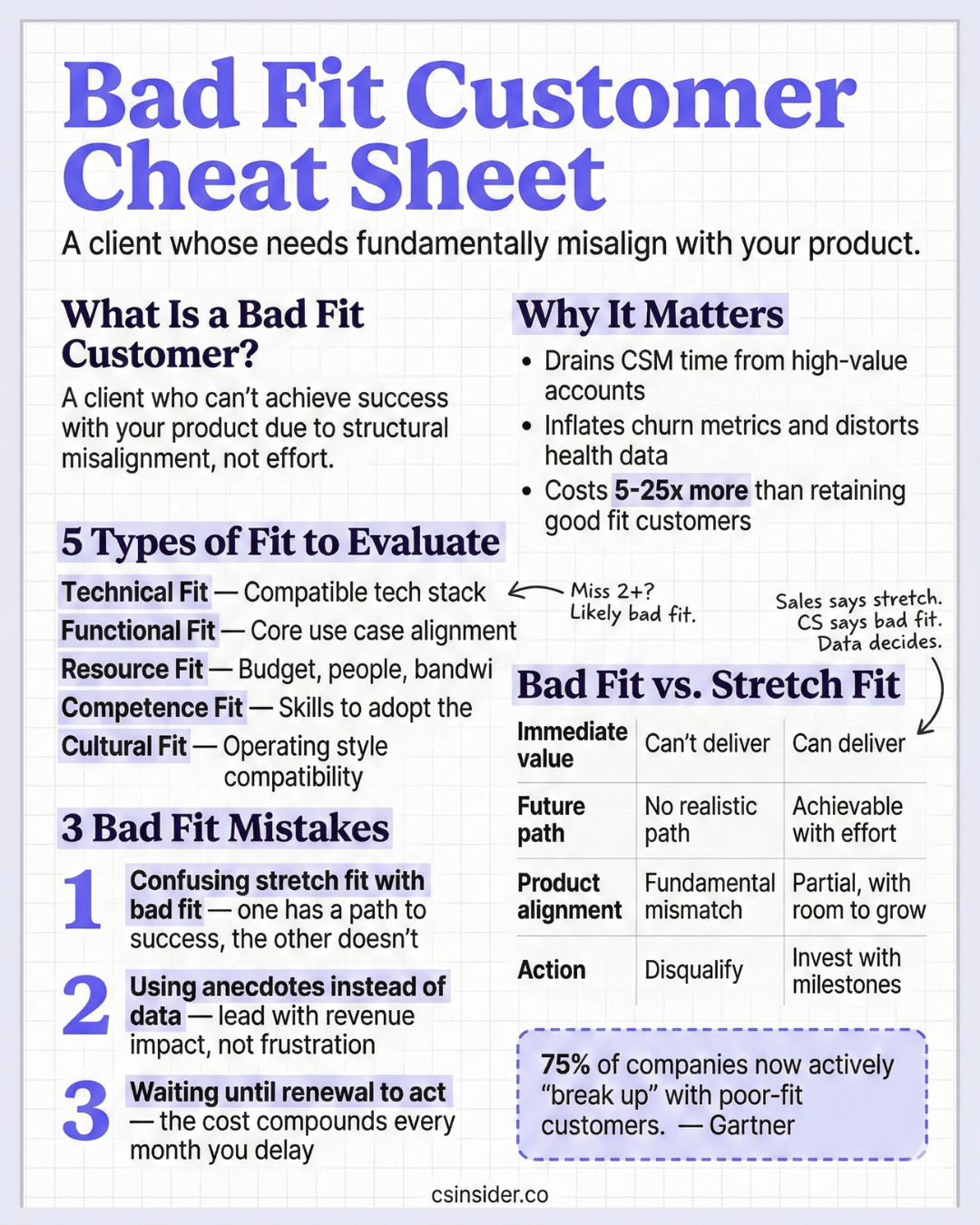
What is a bad fit customer?
A bad fit customer is someone your company cannot help succeed. Customer success consultant Lincoln Murphy defines it this way: a customer is bad fit when you cannot deliver immediate value, nor can you realistically deliver future value in the required timeframe based on your current resources, products, or capabilities.
The key distinction is success potential. Bad fit customers don't just require extra work—they fundamentally cannot achieve the outcomes they're seeking through your product.
This differs from a "stretch fit" customer, who requires additional attention but has genuine potential for success. Bad fit customers face structural barriers that no amount of effort can overcome.
Here's what makes a customer a bad fit:
- Technical misalignment: Your product doesn't integrate with their core systems
- Functional gaps: They need capabilities you don't offer
- Resource constraints: They lack the budget, staff, or time to implement effectively
- Competence limitations: Their team lacks skills to operate your product
- Experience disconnect: They've never used similar tools
- Cultural incompatibility: Your business models fundamentally conflict
TL;DR – What you need to know
- Bad fit customers have zero success potential—they can't achieve their goals with your product
- Cost extends beyond lost revenue: support burden, reputation damage, and distracted teams
- 36% of CS teams now have sales veto power to filter out poor-fit prospects
- Six types of fit determine success potential: technical, functional, resource, competence, experience, and cultural
- Prevention starts upstream with clear ICP definition and sales-CS alignment
Why bad fit customers hurt your business
The obvious cost is churn. According to ZapScale's 2025 Customer Success Survey, bad fit customers rank among the top three churn reasons alongside budget issues and product dissatisfaction.
But the damage extends beyond lost contracts:
Disproportionate resource consumption. Bad fit customers file more tickets, request more meetings, and escalate more frequently. Your team spends hours trying to make something work that was never going to work, stealing time from customers who could benefit.
Negative market sentiment. When bad fit customers fail to achieve their goals, they conclude your product doesn't work—not that it wasn't right for them. They share this conclusion publicly and with competitors.
Product death cycle. Bad fit customers request features that would supposedly have saved the relationship. If product teams build those features, they chase customers who were never going to succeed anyway, pulling resources from your actual target market.
Team morale. CSMs exist to help customers succeed. When they pour effort into accounts that structurally cannot succeed, it's demoralizing and leads to burnout.
How to identify bad fit customers before they sign
The most effective strategy is preventing bad fit customers from becoming customers. This requires clear qualification criteria and sales-CS alignment.
Define your ideal customer profile
Your Ideal Customer Profile (ICP) establishes characteristics of companies most likely to succeed. A strong ICP includes firmographic criteria, technical requirements, resource thresholds, and behavioral indicators.
Equally important: define your "anti-ICP"—characteristics that disqualify prospects regardless of other factors.
Create a success potential checklist
Before closing any deal, evaluate prospects against six dimensions:
- Technical fit: Do they have required infrastructure?
- Functional fit: Does your product address their core use cases?
- Resource fit: Do they have budget and staff for proper implementation?
- Competence fit: Can their team use your product effectively?
- Experience fit: Have they used similar solutions before?
- Cultural fit: Are your business philosophies compatible?
Red flags in multiple areas signal probable bad fit.
Establish sales-CS feedback loops
CS teams see which customer types succeed and struggle. This intelligence should flow to sales during qualification. A ChurnZero study found 36% of CS teams now have deal veto power.
Effective feedback loops include CS participation in late-stage sales calls, shared dashboards tracking outcomes by segment, and regular reviews of churned accounts.
Recognizing bad fit customers in your portfolio
Sometimes bad fit customers slip through. Here's how to identify them:
Onboarding warning signs:
- Implementation timelines extend far beyond typical schedules
- Customer expectations diverge from what was sold
- Key stakeholders disengage early
- Support ticket volume spikes before go-live
Ongoing red flags:
- Usage patterns never normalize despite interventions
- Support requests focus on fundamental functionality
- Feature requests address problems outside your product scope
Quantitative indicators:
- Time to first value significantly longer than average
- Support tickets per user or per dollar well above benchmark
- Declining engagement despite outreach
- Health scores driven by structural factors
What to do with existing bad fit customers
Once identified, you have options depending on contract terms and the nature of the misfit.
Reset expectations. If customers expect outcomes your product can't deliver, honest conversations might realign understanding. Be direct about what success looks like for their profile.
Transition to alternatives. A customer bad fit for your enterprise platform might succeed with a smaller solution. When no internal alternative exists, consider recommending competitors that genuinely serve their needs—this protects your reputation.
Allow graceful exits. When misfit is fundamental, a clean exit is kindest. Offer flexible terms and professional closure. Customers who leave well often become referral sources later.
Document and learn. Every bad fit customer teaches something. How did they enter your pipeline? What signals did qualification miss? Use this intelligence to improve your process.
Building alignment to prevent bad fit customers
Prevention requires coordinated effort across marketing, sales, and CS.
Shared definitions. Everyone touching prospects should understand your ICP and disqualification criteria. Document clearly and train teams regularly.
Aligned incentives. Compensation that rewards closed revenue without considering customer success creates pressure to sign anyone who'll pay. Incorporate retention metrics or health scores into sales compensation.
Regular ICP review. Your ideal customer profile isn't static. Review quarterly and adjust based on evidence: which customer types actually succeed?
Frequently asked questions about bad fit customers
Q: What is the difference between a bad fit customer and a difficult customer?
A: Difficult customers may be demanding or high-maintenance, but they have genuine success potential with your product. They might require more attention, escalate frequently, or push boundaries on service levels. Bad fit customers, by contrast, cannot succeed regardless of effort. The distinction matters because difficult customers often become advocates once their needs are met, while bad fit customers will likely churn no matter what you do. Focus your CS resources on difficult customers who can eventually succeed, and invest in preventing bad fit customers from signing on.
Q: How do I convince sales not to close bad fit deals?
A: Start with data. Track outcomes by customer segment and calculate the true cost of bad fit accounts, including support burden, churn timing, and referral impact. Present this analysis to sales leadership, showing that bad fit customers often cost more to acquire and serve than they generate in revenue. Propose collaborative qualification processes where CS provides input before contracts close. Frame the conversation around shared goals: longer customer lifetimes, higher expansion rates, and better team efficiency benefit everyone.
Q: Should our CS team have veto power over sales deals?
A: Veto power can prevent bad fit customers from entering your portfolio, but it often signals deeper organizational dysfunction. If sales and CS have fundamentally misaligned incentives or conflicting definitions of success, veto authority creates adversarial dynamics. The better approach is building shared understanding of customer fit criteria and incorporating CS perspective throughout the sales process, not just at the end. Reserve formal veto for situations where collaboration fails.
Q: How quickly can you tell if a customer is bad fit?
A: Warning signs often emerge within the first 30-60 days. Onboarding delays, misaligned expectations, and support escalations during implementation suggest fundamental fit issues. However, some problems only surface later when customers attempt advanced use cases or scale usage. Implement health monitoring from day one and create escalation paths for concerns about fit. The earlier you identify issues, the more options you have to address them.
Q: Can bad fit customers ever become good customers?
A: Rarely. Bad fit indicates structural misalignment that typically can't be resolved through effort or time. However, customers sometimes appear bad fit due to temporary circumstances. A company undergoing leadership transition might initially seem disengaged but stabilize later. A resource-constrained startup might grow into your ideal profile. Distinguish between structural bad fit, which requires fundamental change your product can't deliver, and situational challenges that may resolve. Focus retention efforts on the latter.
Q: How do you track the cost of bad fit customers?
A: Calculate direct costs including support hours, implementation overruns, and escalation handling. Add opportunity costs from time diverted from promising accounts. Factor in reputation costs by tracking negative reviews, lost deals attributed to references, and market sentiment. Compare these totals against the revenue generated. Most organizations find bad fit customers are revenue-negative when fully costed. Use this analysis to justify investment in better qualification and alignment.
Q: What role does marketing play in preventing bad fit customers?
A: Marketing shapes who enters your pipeline in the first place. Targeting, messaging, and lead qualification all influence customer fit. If marketing generates leads outside your ICP, sales faces pressure to close whatever's available. Align marketing on your ideal customer profile and measure lead quality, not just quantity. Review messaging to ensure it accurately represents your product's capabilities and target use cases. Marketing that attracts the right prospects makes everything downstream easier.
Q: How do we handle bad fit customers who refuse to leave?
A: Customers under contract have the right to remain customers, even if they're not succeeding. Focus on managing the relationship efficiently rather than investing disproportionate resources. Set clear expectations about what support you can provide. Document interactions carefully. At renewal, have honest conversations about whether continuing makes sense for both parties. Price renewals to reflect the true cost of service. Some bad fit customers will self-select out when they understand the relationship's limitations.
Conclusion
Bad fit customers represent one of the most expensive problems in customer success. By understanding what makes a customer bad fit, building qualification systems that prevent mismatches, and creating organizational alignment around customer success, CS teams can protect their portfolios and focus resources where they generate genuine value.
Key takeaways
- Bad fit customers lack success potential and will likely churn regardless of CS investment
- Prevention through clear ICP definition and sales alignment is more effective than remediation
- Quantifying the full cost of bad fit customers builds the business case for better qualification
What to do in the next 7 days
- Audit your current customer base for accounts showing multiple bad fit warning signs—identify the top 5 accounts consuming disproportionate resources
- Document your qualification criteria by meeting with sales to review your success potential checklist across the six fit dimensions
- Calculate one bad fit cost by selecting a recent churned customer and tallying total support hours, implementation costs, and reputation impact