The best CSM on the team just got promoted to senior. Six months later, they're drowning.
They're still jumping on every escalation call. Still running every renewal conversation personally. Still building one-on-one relationships with every stakeholder because that's what made them exceptional at the last level.
That's exactly the problem.
Career growth in customer success looks straightforward on paper. Associate → CSM → Senior → Manager → Director → VP. Each step feels like doing the same job at a bigger scale with bigger accounts. But the CSMs who get stuck, and plenty do, usually aren't just missing skills. They're holding onto the wrong ones.
What separates CSMs who keep advancing from those who plateau is knowing which skills to let go of, and when. Three career transitions define that path.
TL;DR
- CSM career growth happens through three phase shifts where the nature of your work fundamentally changes
- Bigger accounts and more responsibility don't equal a higher career level without a shift in how you think and operate
- At each transition, what you need to stop doing matters more than what you need to start
- Most CS orgs lack clear skill expectations by level, leaving CSMs guessing about what "senior" really means
- The senior level is a legitimate career destination, not a stepping stone you have to leave
Bigger accounts don't make you senior
Here's how career levels work at most CS orgs: you start with SMB accounts, move to mid-market, then enterprise, then strategic. More revenue, more complexity, more responsibility.
That's a scope ladder. It measures what you're responsible for. It says nothing about how you think, how you solve problems, or how you create value beyond your own book of business.
A CSM managing $5M in ARR who's still running the same customer success playbook they used at $500K is overscoped. They aren't senior. And this confusion is common. Few CS orgs have clear skill expectations by level. Most are promoting based on tenure and account size.
Honeycomb's engineering team ran into this problem. When they measured career progression by scope alone, people chased the biggest projects, not the most important ones. Smart work on small, high-impact problems got overlooked.
So they added a second axis: ownership. How do you approach the work? Are you executing playbooks, designing processes, discovering solutions, or discovering problems? Two people can have the same scope and be at completely different career levels based on that answer.
CS needs both axes too. Scope tells you what someone is responsible for. Ownership tells you how they think about it. A mid-level CSM executing onboarding playbooks flawlessly is at a different level than one redesigning the onboarding process itself. Both are different from someone who identified that the real problem was never onboarding at all. It was sales setting the wrong expectations.
The foundational CSM skills (writing, running meetings, executive networking, consulting, and commercial negotiation) matter at every level. But how you apply them changes completely at each phase shift. Three transitions define how that ownership evolves.

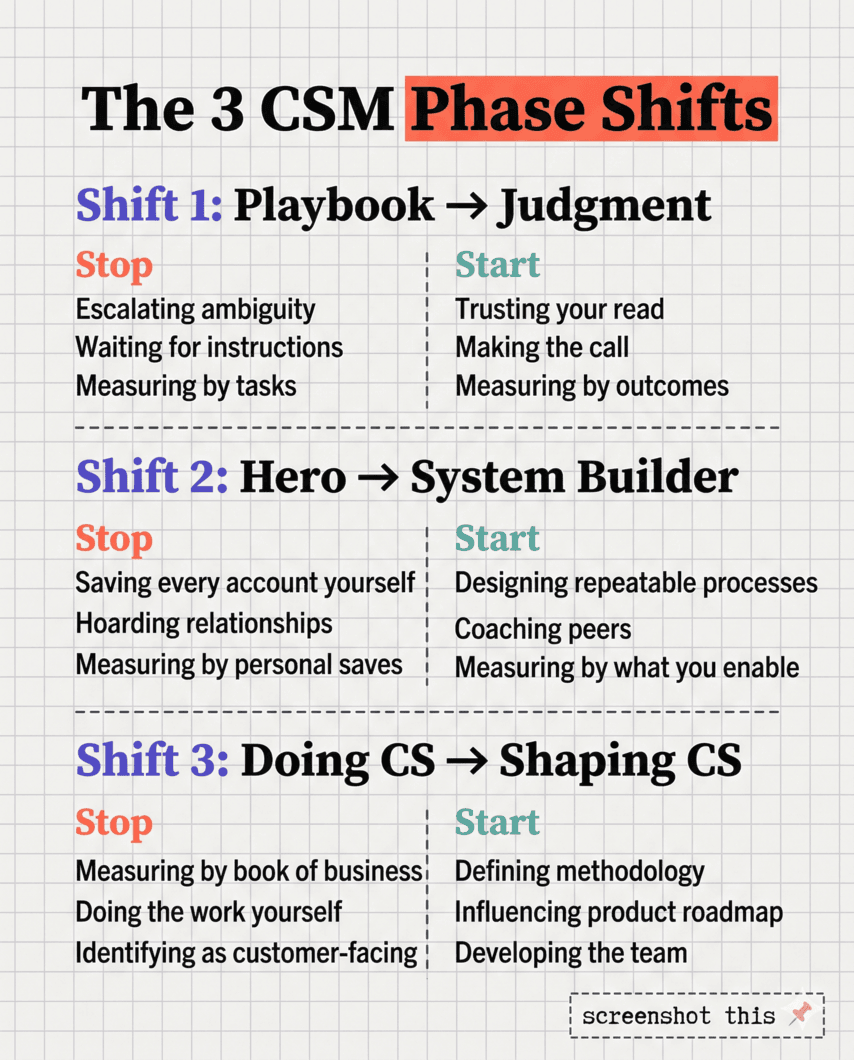
Shift 1: From playbook follower to outcome owner
Most CSMs think the jump from associate to mid-level is about handling more accounts or harder customers. It looks like a volume increase from the outside.
From the inside, the shift is completely different.
At the associate level, the playbook is your safety net. You follow the customer escalation process because someone wrote it down. You run the QBR template because that's the template. You ask your manager when something feels ambiguous because asking feels safer than guessing wrong.
Then something changes. You're on a call with a customer who says "things are going great," and your stomach tightens. Nothing in the health score dashboard flags the account. The usage data looks fine. But you heard a pause before they said "great." You noticed they didn't mention the rollout they were excited about last quarter. You caught that their VP dropped off the meeting invite two weeks ago. None of these are in any playbook. You just... noticed.
The Dreyfus model of skill acquisition describes five stages of expertise, and the critical jump is from "competent" (follows rules well, makes solid plans) to "proficient" (reads situations holistically, acts on pattern recognition before conscious analysis catches up). That gut feeling on the call? You've been through enough customer conversations that your brain connects signals faster than any checklist can.
Not time in the seat, but reps that changed how you think. A CSM with three years who walks into a quarterly business review and feels the energy shift when pricing comes up is operating at a higher level than someone with eight years who still waits for the dashboard to tell them which accounts need attention. Ten years of experience following the same rules is one year of experience repeated ten times.
The CSM's guide to pattern recognition goes deeper on building this skill deliberately. But it only sticks if you let go of the safety net. Stop escalating every ambiguous situation. Stop waiting for instructions. Stop treating the playbook as law and start treating it as a starting point your judgment overrides when the situation calls for it.
Shift 2: From customer hero to system builder
This one hurts because the thing you need to let go of feels like your identity.
You built your reputation by being the CSM who saves accounts. The one clients ask for by name. The one with the highest renewal rate because you personally run every renewal conversation, handle every escalation, and remember every stakeholder's dog's name. Your manager loves you. Your customers love you. You're the best at what you do.
And that's exactly what will keep you from making senior.
And every save makes it worse. Every time you personally save an account, you get rewarded. Your manager highlights it in the team meeting. The customer sends a thank-you email you forward to leadership. Your confidence grows. So you keep doing it. You take the 9pm escalation call because you're the only one who knows the account well enough. You prep the QBR yourself because it'll be faster than explaining it to someone else. You hold the relationships so close that when you go on vacation, three accounts go dark.
You've made yourself irreplaceable.
"Irreplaceable" is a trap disguised as a compliment.
Because if nobody else can do what you do, you can never move to the work that matters at the next level.
If this sounds familiar. We've covered the hero trap before. What we haven't covered is the structural reason it's so persistent. Why does every CS org produce hero CSMs who then get stuck?
CS has three hidden layers:
- Layer 1: Customer execution. Running onboarding, QBRs, renewals, and escalations. What 90% of CSM training covers.
- Layer 2: Making things happen internally. Managing cross-functional relationships with sales, product, and support. Influencing without authority to get things done for customers.
- Layer 3: Strategic influence. Shaping CS methodology, driving revenue strategy, and defining what "success" means for the organization.
Most CSMs get stuck between layers 1 and 2 because they weren't aware layer 2 existed. You can be the hardest-working CSM on the team and still be operating entirely in layer 1.
Breaking out means giving up the thing that got you here. Design a process that another CSM could run without you. Coach a peer through the next escalation instead of taking it over. Build a cross-functional relationship with product that creates value beyond your own accounts. And stop measuring your worth by saves. If your playbook only works when you personally run it, you're a retention risk for your company, not a promotion candidate.
Shift 3: From doing CS to shaping CS
Here's a question most career frameworks never ask: Does the CS org operate differently because you're in it?
Not your accounts. Not your renewal rate. The organization.
If you stripped your name off the org chart tomorrow, would anything structural change?
- Would the onboarding playbook be different?
- Would product get fewer customer insights?
- Would the junior CSM who handled their first executive escalation last week have done it the same way without your coaching?
If the answer is mostly no, you're still doing (not shaping) CS. No matter what your title says.
This shift is the hardest to see because the work stops looking like CS. You're in product roadmap meetings presenting churn patterns the product team doesn't know exist. You're rewriting the expansion playbook because the current version assumes every customer follows the same adoption curve. You're building the business case for a new customer health score model that weights leading indicators differently.
None of that shows up in a standard CS dashboard. That's the point.
You know what does show up on the dashboard? The customer call you jumped on this morning because it felt urgent. The QBR you prepped yourself because it was faster than coaching someone through it. The escalation you handled personally because you still could.
That pull back toward Layer 1 work never fully goes away. It's familiar. It's rewarding. And every hour you spend there is an hour you didn't spend on the work that only you can do at this level.
A Strategic CSM whose work hasn't fundamentally changed since their mid-level days is operating below their level, no matter what the title says.
At this tier, your book of business still matters. You're likely managing the most complex, highest-value accounts in the org. But it stops being the only thing that makes you valuable. What separates this level from a Senior CSM with bigger accounts:
- Whether the methodology you built changed how new CSMs ramp
- Whether your product roadmap influence prevented churn that never showed up in the data because the friction got fixed upstream
- Whether the CSM you mentored six months ago just handled something independently that used to escalate to you
That's layer 3. You still deliver on your accounts. You also shape how everyone else delivers on theirs.
This is also where the career fork appears. The IC track and management track diverge here, but at senior-plus levels, they converge again. Both are fundamentally about leadership and influence, just through different mechanisms. If you're weighing that decision, the CSM to Manager transition piece goes deeper on what that jump looks like.
Senior CSM is a destination, not a rest stop
There's one more concept CS hasn't adopted yet: a senior level designed for staying, not just passing through.
Some companies have already built this: a senior IC level where you keep growing within the role, you're well-compensated, and nobody pushes you toward management because you've "been here long enough." CS hasn't caught up. Comp structures, budget constraints, and a cultural bias toward management as the only "real" career growth all work against it.
But the concept still matters for how you think about your own career.
Are you staying at senior because the work energizes you, or because the next shift feels too uncomfortable to attempt?
A thriving Senior CSM is deepening their expertise every quarter. They're taking on accounts that stretch their pattern recognition. They're refining the systems they built last year because they found the gaps. They're the person a newer CSM calls before they call their manager. They chose this level because it's where they do their best work.
A stalling Senior CSM is running the same playbook they ran two years ago. They've stopped building systems and started maintaining them on autopilot. They avoid the cross-functional work that Shift 3 requires because it's ambiguous and uncomfortable. Same title. Completely different trajectory.
If you're at senior and you're still growing, that's not a plateau. If you're at senior and you haven't changed how you work in a year, you're not choosing to stay. You're avoiding the next shift.
The question isn't whether you advance to the next level. The question is whether you're aware of what each shift requires, so you can choose deliberately. If you're unsure where your strengths sit right now, the breakdown of why your best CSM work feels invisible is a good place to start.
Frequently asked questions
Q: How long does each phase shift typically take?
A: There's no fixed timeline. Some CSMs make the first shift in 18 months. Others take four or five years. The Dreyfus model of skill acquisition shows that progression depends on the quality of your experience, not the quantity. Repetitive work without reflection doesn't accelerate growth, even over a decade.
Q: Can you skip a phase shift?
A: Not effectively. Each shift builds the foundation for the next one. A CSM who moves into a strategic role without developing systems-thinking skills (Phase Shift 2) will default to doing the work themselves, which doesn't scale at that level.
Q: What if my company doesn't have a strategic or principal CSM role?
A: The skills still apply even without the title. Building systems, coaching peers, and influencing cross-functionally all create value regardless of what your org chart looks like. These are also the skills that make you competitive if you decide to move to a company that does have those roles.
Q: How do I know which phase shift I'm currently in?
A: Look at how you spend your time and how you make decisions. If you're still following playbooks closely, you're pre-Phase Shift 1. If you're making judgment calls but doing all the work yourself, you're between 1 and 2. If you're building systems but still measuring yourself by your own accounts, you're between 2 and 3.
Q: Is the management track better than the IC track?
A: Neither is inherently better. At senior-plus levels, both tracks require leadership and influence. The difference is mechanism: managers lead through team development and organizational structure. Strategic ICs lead through methodology, mentorship, and cross-functional influence. Choose based on how you create the most impact, not which title sounds more impressive.
Q: What should I bring to my next one-on-one after reading this?
A: Ask your manager two questions. First: "What does success look like at the next level, specifically in terms of how I work, not just what I'm responsible for?" Second: "What should I stop doing that's keeping me effective at my current level but limiting me for the next one?"
.png)