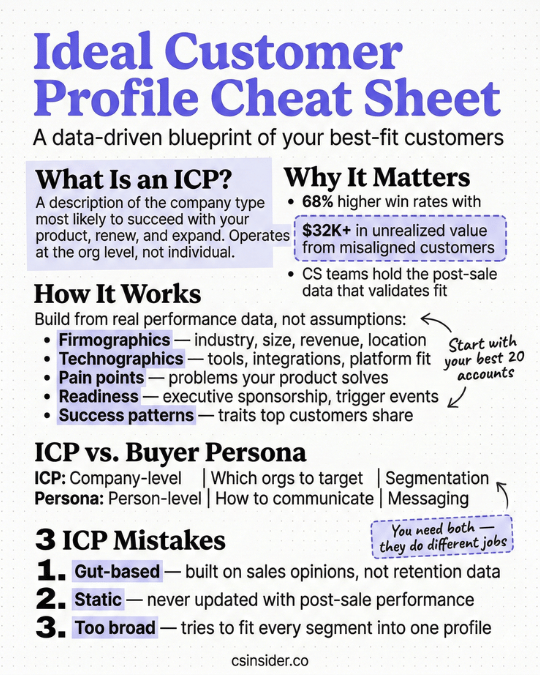
An ideal customer profile is a data-driven description of the type of company most likely to succeed with your product, renew consistently, and expand over time. It captures organizational traits (industry, size, tech stack, business model) that predict long-term fit and value. For customer success teams, a strong ICP isn't a sales tool you inherit. It's the foundation for every segmentation decision, health score, and renewal forecast you build.
TL;DR – What You Need to Know
- An ICP defines the organizational characteristics of your best-fit customers, not individual buyers
- Companies with well-defined ICPs report 68% higher win rates and 36% shorter sales cycles (Apollo, 2025)
- 50% of prospects are likely not a good fit for what you sell (Sales Insights Lab)
- CS teams hold the post-sale data that validates or disproves your ICP
- Review and update your ICP quarterly using retention, expansion, and support data
What is an ideal customer profile?
An ideal customer profile is a detailed framework that describes the type of organization that gets the most value from your product or service and, in return, delivers the most value to your business. It combines quantitative data points (company size, annual revenue, technology stack) with qualitative signals (business maturity, pain points, buying behavior) to create a targeting blueprint.
The key word there is "organization." An ICP operates at the company level, not the individual level. It answers the question: which types of businesses should we pursue, retain, and invest in?
For CS teams, the ICP plays a different role than it does for sales and marketing. Sales uses the ICP to fill the pipeline. CS uses it to understand why certain accounts thrive while others drain resources. You're the team that sees what happens after the contract is signed, which means you're sitting on the data that proves whether the ICP is accurate.
A strong ICP typically includes five categories of information: firmographic data (industry, revenue, headcount), technographic data (existing tools and integrations), behavioral signals (buying patterns, engagement levels), pain point alignment (problems your product solves), and success indicators (traits your highest-performing customers share).
Why your ideal customer profile matters in customer success
Every CS leader has felt this tension: your team is working harder than ever, but churn keeps creeping up and expansion conversations stall. Often, the root cause isn't your playbook or your people. It's the customers sitting in your book of business.
When sales closes deals outside the ICP, those accounts land on your desk. They need more hand-holding during onboarding. They file more support tickets. And when renewal time comes, the ROI conversation gets uncomfortable because the product was never built for their use case.
According to research from Apollo (2025), companies with well-defined ICPs see 68% higher account win rates and 36% shorter sales cycles. But the downstream impact matters even more. ICP-aligned customers adopt faster, expand more naturally, and renew without the last-minute scramble that eats up your Q4.
Gartner projected that 75% of companies would actively part ways with poor-fit customers, recognizing that the cost of retaining misaligned accounts often exceeds the cost of acquiring good ones. That projection has played out. CS teams across SaaS are building "anti-ICP" profiles to flag accounts that should never have been sold in the first place.
The math is straightforward. When your customer lifetime value is $50,000 for ICP-aligned accounts but drops to $18,000 for misaligned ones, every bad-fit deal costs you $32,000 in unrealized value. Multiply that across a dozen accounts and you're looking at a retention problem disguised as a revenue problem.
ICP vs. buyer persona: two tools, two jobs
These two concepts get confused constantly, and the confusion creates real problems. Teams end up building ICPs that describe people instead of companies, or buyer personas that list company attributes instead of individual motivations.
An ICP defines the organization. A buyer persona defines the person inside that organization who makes or influences the buying decision. You need both, but they serve completely different purposes.
Your ICP tells you which companies to target. Your buyer persona tells you how to talk to the humans at those companies. One filters your pipeline. The other shapes your messaging.
For CS teams specifically, the ICP determines your customer segmentation model. It's how you decide which accounts get high-touch engagement versus digital-led coverage. The buyer persona, on the other hand, helps you figure out who to build relationships with inside those accounts and what language resonates with them.
Five data points that shape a strong ICP
Building an ICP on gut feeling is tempting, especially when your sales team has strong opinions about "dream customers." But the ICPs that hold up under pressure are built from actual customer performance data. These are the five categories that matter most.
Firmographic fit
This is the foundation: industry vertical, company size, annual revenue, geographic location, and business model. You're looking for patterns among your most successful customers. If your top 20 accounts by gross revenue retention are all mid-market SaaS companies between 200 and 1,000 employees, that's a signal worth paying attention to.
Technographic compatibility
Which tools and platforms do your best customers already use? Integration compatibility is one of the strongest predictors of successful onboarding and long-term adoption. If your product requires a specific CRM or data warehouse to deliver full value, that needs to be in the ICP.
Pain point alignment
Your product solves specific problems. Your ICP should reflect the companies that actually experience those problems acutely enough to invest in a solution. The gap between "nice to have" and "need to fix this quarter" is where deals either stick or fall apart post-sale.
Readiness indicators
This is where many ICPs fall short. Beyond firmographics and pain points, you need signals that the company is ready to implement and adopt your product. That might mean having a dedicated team for your product category, executive sponsorship for the initiative, or a recent trigger event (new funding round, leadership change, failed implementation of a competitor).
Success pattern matching
Look at your customers with the highest health scores and strongest retention. What do they have in common beyond the obvious demographics? Maybe they all went through a structured onboarding. Maybe they have an internal champion who drives adoption. These behavioral patterns belong in your ICP just as much as industry and company size.
CS owns the ICP after the sale
Here's where customer success teams have an advantage that most organizations underuse. Sales sees prospects for weeks or months. CS sees customers for years. That long-term view reveals patterns that no amount of pre-sale research can surface.
Most teams discover their ICP is wrong about six months after a big push into a new segment. The support tickets pile up. Onboarding timelines stretch. Renewal conversations get awkward. By then, the damage to retention metrics is already baked in.
CS teams can break this cycle by building a feedback loop that flows back to sales and marketing. The approach that high-performing teams use looks like this:
- Quarterly ICP audits. Pull retention, expansion, and support data by customer segment. Compare ICP-aligned accounts against misaligned ones across every metric that matters: time to value, NPS, support volume, churn risk, and expansion rate.
- Anti-ICP documentation. Just as valuable as knowing who fits is knowing who doesn't. Track the traits of customers who churned within the first year. Look for patterns in company size, industry, use case, or buying behavior. Share this with sales as a disqualification guide, not a suggestion.
- Closed-lost vs. churned analysis. Compare the traits of deals that sales lost against customers CS lost. If they look similar, your ICP is probably accurate. If they look different (sales is losing the "right" customers while CS is losing the "wrong" ones), your pipeline has a qualification problem.
We've all inherited a customer list with a few accounts that make you wonder what sales was thinking. The ICP feedback loop is how you prevent that from happening again.
McKinsey research found that companies excelling at personalization generate 40% more revenue than average performers. For CS teams, that personalization starts with knowing exactly which customers belong in your book and tailoring your engagement model accordingly. A one-size-fits-all approach doesn't work when your portfolio includes accounts that range from perfect fit to "why are we servicing this?"
Frequently asked questions about ideal customer profile
Q: How do you create an ideal customer profile?
A: Start by analyzing your existing customer base. Identify your top-performing accounts by retention rate, expansion revenue, and satisfaction scores. Look for shared characteristics across firmographics, technographics, and behavioral patterns. Validate your findings with data from sales, marketing, and customer success teams before finalizing.
Q: What's the difference between an ICP and a buyer persona?
A: An ICP describes the type of company that's the best fit for your product, using traits like industry, size, and tech stack. A buyer persona describes the individual decision-maker within that company, including their role, motivations, and challenges. You need both for effective go-to-market execution.
Q: Why is an ideal customer profile important for customer success?
A: CS teams inherit every deal sales closes. When those deals match the ICP, customers adopt faster, need less support, and renew more predictably. When they don't, CS teams spend disproportionate time on accounts unlikely to succeed, which drives up churn and drags down team morale.
Q: How often should you update your ideal customer profile?
A: Review your ICP quarterly using post-sale performance data. Major updates should happen when you enter new markets, launch significant product changes, or notice shifts in which customer segments are retaining and expanding. An ICP that hasn't been updated in over a year is likely outdated.
Q: What data points should an ICP include?
A: A strong ICP includes firmographic data (industry, size, revenue), technographic data (existing tools and integrations), pain point alignment, readiness indicators (executive sponsorship, trigger events), and success patterns derived from your highest-performing current customers.
Q: Can a company have more than one ideal customer profile?
A: Yes. If you serve distinct segments with different needs, buying journeys, or use cases, separate ICPs for each segment will improve targeting accuracy. Many SaaS companies maintain two to three ICPs organized by company size tier (SMB, mid-market, enterprise) or by vertical.
Q: How does ICP alignment affect churn?
A: Bad fit customers who fall outside your ICP are significantly more likely to churn. They struggle to realize value from your product, generate more support burden, and rarely expand. Research consistently shows that poor product-customer fit is among the top drivers of SaaS churn.
Conclusion
A well-defined ideal customer profile is the connective tissue between your go-to-market strategy and your retention outcomes. It determines who lands in your book, how much effort each account requires, and whether your team spends its energy on customers who can succeed or ones who were never the right fit.
Key takeaways:
- Your ICP should be built from post-sale performance data, not sales intuition alone
- CS teams are uniquely positioned to validate, refine, and enforce ICP standards
- Every misaligned account costs you more than the revenue it generates
What to do in the next 7 days
- Pull a retention report segmented by customer type. Compare your top-performing accounts against your bottom performers on renewal rate, expansion revenue, and support ticket volume. Note the firmographic and behavioral differences.
- Draft an anti-ICP. Document the three to five traits shared by customers who churned in the past year. Share it with your sales team as a disqualification reference.
- Schedule a cross-functional ICP review. Set up a 30-minute meeting with sales and marketing to compare their ICP assumptions against your post-sale data. Bring the numbers.