
You've got a customer using your product well. They're a clear fit for an upgrade or add-on. The timing feels right.
So you bring it up. And they say "not right now."
Most CSMs take this at face value. They assume the timing was off. Or they pushed too hard. They back off and wait for a better moment.
But here's what's actually happening: the conversation was lost before you opened your mouth.
The issue isn't handling pushback. It's being unprepared for what expansion conversations actually require.
TL;DR
- Most expansion failures trace back to missing prep work, not bad timing
- Three questions determine whether you're ready for the conversation
- Pushback tells you exactly which piece is missing
- One question turns objections into a roadmap you can act on
- Expansion isn't selling—it's diagnosing fit and timing together
What CSMs think drives expansion vs. what does
There's a gap between how CSMs approach expansion and what actually moves it forward.
What most CSMs rely on:
- Good timing. Waiting for renewal season or a moment when the customer seems happy.
- Obvious product gaps. Assuming the customer will see the value themselves.
- A strong relationship. Trusting that rapport will carry the conversation.
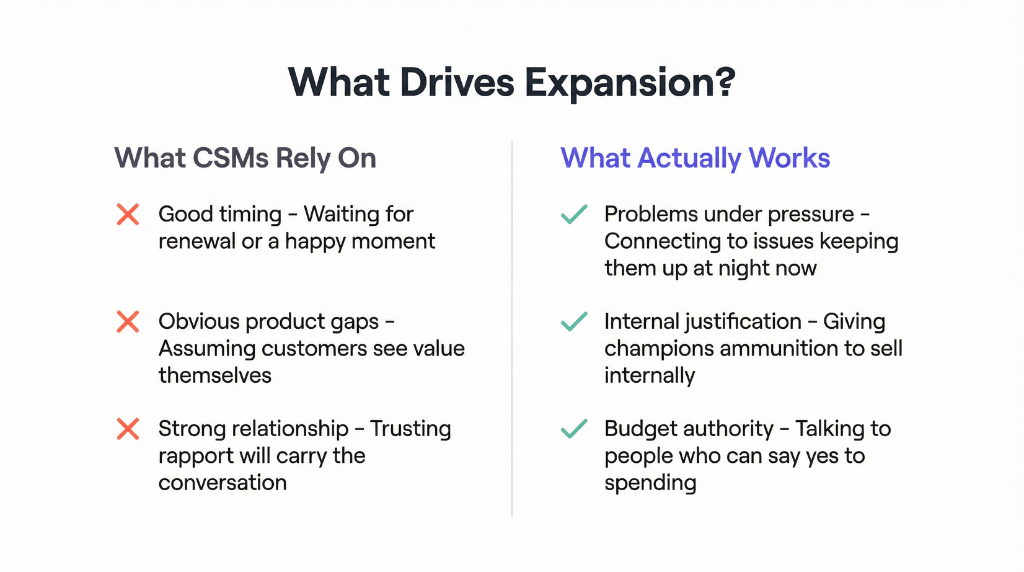
What drives expansion:
- Connecting new capabilities to problems they're already under pressure to solve. Not features they might find useful someday—problems keeping them up at night right now.
- Helping them build internal justification. Your champion might love the idea. But they need ammunition to sell it internally.
- Talking to people with budget authority. The person who uses your product daily often isn't the person who can say yes to spending more.
The gap between these two lists explains most stalled expansion conversations. You're relying on relationship and timing. They need business case and authority.
Three questions to answer before you bring up expansion
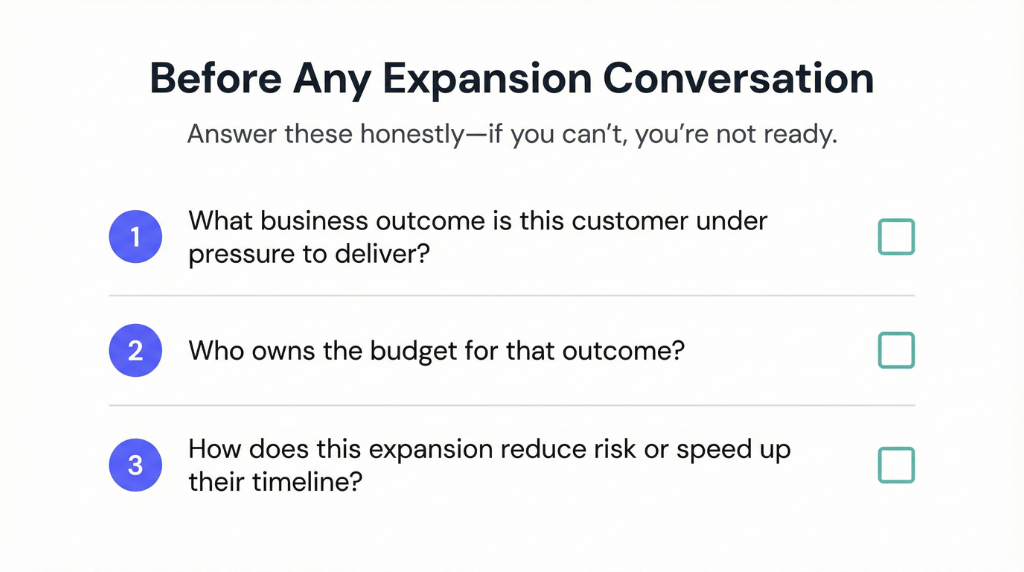
Before any expansion conversation, answer these honestly:
1. What business outcome is this customer under pressure to deliver?
Not what they're using your product for. What result is their leadership measuring them on? Revenue target? Retention number? Efficiency metric? If you don't know, you're guessing at relevance.
2. Who owns the budget for that outcome?
Your day-to-day contact might love your product. But expansion dollars usually come from somewhere else. Who controls that budget? Have you talked to them? Do they even know you exist?
3. How does this expansion reduce risk or speed up their timeline?
Customers don't buy features. They buy faster results or fewer headaches. Can you articulate exactly how this expansion helps them hit their number sooner or with less friction?
If you can't answer all three, you're not ready for the conversation. And pushback is almost guaranteed.
What each objection reveals about your prep work
.png)
When a customer pushes back, they're giving you information. Each response maps directly to something missing from your prep work.
"We're not using what we have."
Translation: They don't see current value clearly. You haven't connected what they're already paying for to outcomes they care about. Expansion feels premature because the foundation isn't solid.
Before you pitch more, help them see the ROI of what they've got.
"We need to check with leadership."
Translation: You're talking to someone who can't say yes. Your contact might be enthusiastic, but they don't control the budget. You've built a champion without building a path to the decision-maker.
Ask who else would need to weigh in. Then figure out how to get in front of them.
"It's not in the budget."
Translation: You haven't connected to a problem they're funded to solve. Every company has money for priorities. If expansion isn't landing, it means you haven't linked it to something already on their financial radar.
Find out what they are funded to fix. Then reframe.
"Maybe next quarter."
Translation: The pain isn't urgent enough yet. They see some value, but not enough to act now. Something else is more pressing.
Dig into what's competing for their attention. Sometimes the answer is patience. Sometimes it's repositioning.
Each objection is diagnostic. Stop trying to overcome pushback. Start trying to understand it.
The question that turns pushback into a roadmap
When you hit resistance, one question changes the dynamic:
"What would need to be true for this to make sense for your team?"
This works because it's forward-looking. You're not asking them to defend their hesitation. You're asking them to describe the conditions for yes.
Their answer gives you the roadmap. Maybe it's timing. Maybe it's proof of value. Maybe it's a different stakeholder. Maybe it's a budget cycle. And sometimes it's genuinely not a fit—which is useful to know early.
The question also shifts your role. You're not selling. You're problem-solving together. That's what trusted advisors do.
Listen carefully to what they say. Then work backward. If they need proof, build a business case. If they need buy-in from leadership, help them get it. If they need to see ROI first, make that visible.
You're not overcoming objections. You're collaborating on conditions.
Stop persuading. Start diagnosing.
Expansion conversations feel awkward when you're caught between "trusted advisor" and "person trying to grow the account."
That tension disappears when you reframe the goal. You're not persuading. You're diagnosing—whether this expansion fits, who needs to be involved, and what conditions would make it work.
Sometimes the answer is "not now." That's fine. You've learned something useful and preserved the relationship.
But more often, pushback just means you were missing something. The customer told you what it was. Now you can fix it.
FAQs: Expansion Conversations for CSMs
Q: What's the most common reason expansion conversations fail?
A: Most expansion conversations fail due to missing preparation, not poor timing or pushback handling. CSMs often don't know what business outcome the customer is under pressure to deliver, who controls the budget, or how expansion reduces risk for the customer. Without these three pieces, you're guessing—and pushback becomes inevitable.
Q: How do I find out who actually controls the budget for expansion?
A: Start by asking your day-to-day contact directly: "If this made sense for your team, who else would need to sign off?" Then research the org structure on LinkedIn and look for titles tied to the business outcome you're addressing. Request an introduction rather than going around your contact—position it as helping them build internal support.
Q: What should I do when a customer says "we're not using what we have"?
A: This signals they don't see clear ROI from their current investment. Before discussing expansion, help them quantify the value they're already getting. Build a simple business case showing how current usage connects to outcomes they care about. Once that foundation is solid, expansion becomes a natural next step rather than a premature ask.
Q: How do I help my champion build internal justification for expansion?
A: Give them the ammunition they need: a one-page business case with projected ROI, specific metrics showing current product impact, and answers to objections their leadership will raise. Frame the expansion around a problem their company is already funded to solve—this makes budget conversations easier because the money already exists for that priority.
Q: When should I avoid bringing up expansion with a customer?
A: Avoid expansion conversations when you can't articulate how it connects to a problem they're actively measured on, when you haven't identified or spoken to the budget holder, or when they're struggling to see value from their current investment. These gaps don't fix themselves with better timing—they require specific prep work first.
Q: What's the difference between selling and diagnosing in expansion conversations?
A: Selling focuses on persuading the customer that expansion is valuable. Diagnosing focuses on determining whether expansion fits their situation right now—and if not, what would need to change. The diagnostic approach asks "what would need to be true for this to make sense?" instead of overcoming objections. This positions you as a problem-solver rather than a salesperson.
.png)