

Your biggest customer just renewed their contract. Full expansion. No discount. The account executive is celebrating, but the real work happened six months ago when a CSM noticed a drop in product usage, looped in the right stakeholders, and rebuilt the business case before anyone said the word "churn."
That's the invisible engine of a great customer success manager. Not a follow-up email. Not a QBR deck full of charts nobody asked for. It's the pattern recognition, the relationship capital, and the strategic instinct that keeps customers buying year after year.
If you've been wondering what a customer success manager actually does, you're not alone. It's one of the most searched and least understood roles in B2B SaaS. And the confusion makes sense, because the job looks completely different depending on who's doing it well versus who's doing it on autopilot.
The gap between those two versions of the role is widening fast. With acquisition costs up 222% over the past five years and SaaS companies now spending $2.00 to acquire just $1.00 in new ARR, every retained customer is worth more than ever.
Here's what the role looks like when it's done right.
TL;DR - What You Need to Know
- A customer success manager owns the post-sale relationship, driving adoption, retention, and expansion revenue
- CSMs prevent churn before it happens by monitoring product usage and customer health signals
- The role has shifted from reactive support to proactive revenue ownership across most B2B SaaS companies
- 84% of B2B tech companies are maintaining or increasing CS budgets even during economic headwinds
- Acquiring new customers costs 5-25x more than retaining existing ones, making CSMs central to profitable growth
- AI now saves CS teams more than 10 hours per week on routine tasks, freeing CSMs for strategic work
What a customer success manager does (beyond the job description)
A customer success manager is the person responsible for making sure customers get real, measurable value from your product after the sale closes. They bridge the gap between what your product can do and what your customer needs it to do, turning a signed contract into an ongoing, growing relationship.
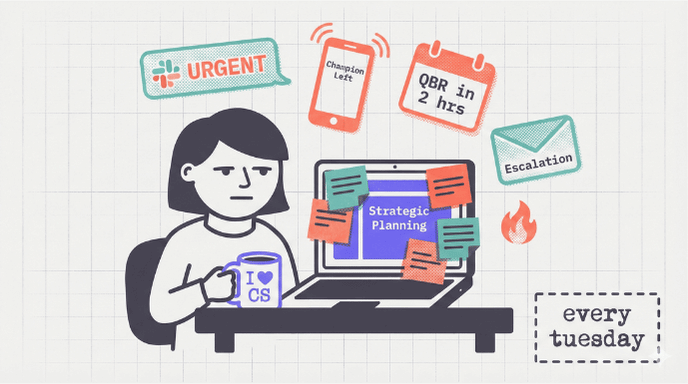
That's the textbook version. Here's what it looks like on a Tuesday morning.
A CSM might start the day reviewing health scores for 30 accounts, flagging two that show declining login activity. By 10 a.m., they're on a call with a mid-market customer who's struggling to get their team to adopt a key feature. After lunch, they're prepping a QBR for an enterprise account, translating product usage data into a story about ROI that the customer's CFO will actually care about. And somewhere in between, they're Slacking the product team about a feature gap that three different customers mentioned this week.
The role sits at a unique crossroads: part consultant, part relationship manager, part revenue driver, part product advocate. Companies that don't have a designated customer success function often spread these responsibilities across account managers, support reps, and sales teams. But the results are never as strong, because nobody owns the full picture.
According to Gainsight's 2024 Customer Success Index, 84% of B2B tech companies are now maintaining or increasing their CS budgets, and 93.7% of companies that measure CS impact are tying it directly to a revenue target. This isn't a "nice to have" department anymore. It's a growth engine.
The core responsibilities every CSM owns
If you asked ten CSMs what they do, you'd get ten slightly different answers. That's because the role adapts based on company size, product complexity, and team structure. But the core responsibilities stay consistent.
Onboarding that sets customers up for long-term success
Onboarding is where the relationship either starts strong or begins to crack. A CSM's job during onboarding isn't to walk someone through a product demo. It's to understand what success looks like for that specific customer and build a path to get there.
This means running kickoff calls to align on goals, configuring the product to match the customer's workflows, and making sure the right people at the customer's company are trained and engaged. Poor onboarding is one of the top predictors of churn. According to the Customer Success Collective, 91% of companies offer live onboarding sessions led by CSMs because generic, self-serve setup simply doesn't work for complex B2B products.
Here's a practitioner observation most articles won't tell you: the biggest onboarding mistakes don't happen during setup. They happen when the CSM rushes to "close" onboarding without confirming the customer has hit their first meaningful value milestone. Completing setup tasks and achieving first value are two very different things.
Driving product adoption and measuring customer health
Once a customer is live, the CSM shifts into ongoing engagement mode. This is where the real strategic work begins, and where average CSMs and great CSMs start to diverge sharply.
Average CSMs schedule monthly check-ins and ask "how's everything going?" Great CSMs are tracking product usage data, monitoring health scores, and reaching out before the customer even knows there's a problem. They watch for signals like declining login frequency, unused features that were a key part of the business case, or a champion leaving the company.
To put this in context, a recent Zendesk benchmark found that more than 50% of customers will switch to a competitor after just one poor experience. CSMs who catch issues early can prevent the kind of silent disengagement that turns into a surprise cancellation at renewal time.
Effective health monitoring usually involves tracking a mix of quantitative and qualitative signals:
- Product usage metrics: Login frequency, feature adoption rates, depth of engagement
- Relationship health: Stakeholder engagement, executive sponsor access, sentiment during calls
- Business outcomes: Whether the customer is actually achieving the goals they set during onboarding
- Support patterns: Spike in tickets, repeated issues, or escalation patterns that suggest frustration
Most teams use some version of a composite health score to track these signals, but the model only works if the inputs reflect real risk. If you suspect your scoring model needs a refresh, here's a deeper look at where health scores break down and how to fix them.
Retention, renewals, and preventing churn
Let's talk about the number that matters most: retention.
Customer acquisition costs in B2B SaaS now average $702 per customer, while retention costs are up to six times lower. A 5% increase in customer retention drives a 25-95% increase in profits, according to research published by Harvard Business Review. And yet, 75% of software companies reported declining retention rates in 2024.
This is exactly why the CSM role exists. Renewal isn't a transaction that happens on a single day. It's the outcome of twelve months of relationship building, value delivery, and strategic alignment. CSMs who treat renewal as a conversation that starts at contract signing, not 90 days before expiration, consistently outperform those who don't.
The mechanics look like this: regular business reviews that tie product value to the customer's business goals, proactive risk identification when engagement drops, and strategic conversations about growth that make the customer feel invested in the partnership. When a CSM does this well, renewal becomes a natural conclusion rather than a negotiation.
One important shift: proving value can't wait for renewal season anymore. The strongest CSMs document business impact as milestones happen throughout the year, building a running value scorecard rather than scrambling to reconstruct the story 90 days before contract expiration. When budget season arrives, the customer should be able to defend the investment before finance even asks.
Driving expansion through upsell and cross-sell
This is where the CSM role has changed the most in the past two years.
Revenue ownership became an operating norm in 2024, and owning a growth target followed in 2025. According to the Gainsight CS Index, CS teams are increasingly expected to identify and drive expansion revenue, not just set up opportunities for sales.
It costs SaaS companies $1.78 to acquire a dollar in ACV from new customers, compared to just $0.61 from expansions and upsells of existing customers, per KeyBanc Capital Markets. That math is why companies are shifting budget from acquisition to post-sale growth, and why CSMs who can spot and nurture expansion opportunities are among the most valuable people in the building.
This doesn't mean CSMs are becoming salespeople. The best expansion conversations happen naturally when a CSM has already demonstrated clear ROI and built trust. A customer who sees results from your platform is 60-70% more likely to purchase additional products, compared to just 20% for a new prospect. That trust gap is what CSMs create. (If you're looking for a practical breakdown of how to handle expansion pushback, we covered that separately.)
How the CSM role is evolving in 2026
The customer success manager role you see in a 2020 job description barely resembles the role today. Three major shifts are reshaping what it means to be a CSM.
From relationship manager to revenue driver
The "happiness department" label is officially dead. CSMs are now measured on gross revenue retention, net revenue retention, and expansion targets alongside traditional metrics like NPS and health scores.
This shift forces a meaningful change in how CSMs approach their work. Instead of asking "is the customer happy?", the question becomes "is the customer achieving outcomes that justify continued and growing investment?" It's a subtle but critical distinction. A customer can be happy with your product and still churn if their business priorities shift and nobody on your side noticed.
The pressure has intensified heading into 2026. As a recent analysis of 30+ expert predictions found, CS now owns the expansion forecast the same way sales owns new ARR. Boards expect NRR predictions with the same rigor as new logo forecasts. And "grow with fixed headcount" has become the default operating model, which means every CSM needs to demonstrate results-per-hour, not just activity volume.
The best CS organizations are training their CSMs to speak the language of business outcomes. That means framing QBRs around revenue impact, not feature adoption. It means building executive relationships beyond the day-to-day champion. And it means understanding enough about the customer's industry to connect product value to strategic priorities.
AI is changing what CSMs spend time on
More than half of CS organizations are now using AI in their workflows, according to Gainsight's 2024 research. AI is automating tasks like data entry, health score calculation, and churn risk detection, saving CS teams more than 10 hours per week.
But here's the part that matters for the role: AI isn't replacing CSMs. It's making the strategic parts of the job more important. When routine tasks are automated, the CSMs who thrive are the ones who can do the things AI can't do well: build genuine relationships, navigate complex organizational dynamics, have difficult conversations about underperformance, and translate messy human problems into product solutions.
The gap between AI-enabled CS organizations and everyone else is widening fast. Generic AI assistants that answer questions about customers are table stakes now. The real gains are coming from purpose-built agents designed for specific workflows, like flagging expansion opportunities with reasoning or drafting strategic recommendations based on top-performing CSM patterns. Teams that plugged AI into broken processes in 2025 found it amplified the mess rather than fixing it. The organizations pulling ahead fixed their workflows first, then automated.
Digital customer success is also expanding rapidly. Self-service portals and online communities surged from 42% adoption in 2023 to 73% in 2024. This means CSMs are increasingly focused on high-touch, high-value activities while digital tools handle scaled engagement for lower-touch accounts.
Specialization is replacing the "full-stack" CSM
The era of the CSM who does everything is winding down. The generalist job description that combined strategic advisor, project manager, product expert, and data analyst was always three jobs masquerading as one. Companies are finally acknowledging that.
Two distinct tracks are emerging. Strategic CSMs focus on high-value accounts, executive relationships, and business outcomes. They manage fewer accounts but drive expansion and long-term value. Orchestrator CSMs manage operations, coordinate cross-functional teams, and build systems that serve many customers at scale. Both are critical. They require fundamentally different skill sets.
Product knowledge is getting commoditized. Customers ask AI how to use features. Best practices are documented. Implementation playbooks are automated. What remains is strategic influence: understanding the customer's business well enough to challenge their thinking, connect dots they're missing, and shape their strategy. That's the piece that can't be replicated by a knowledge base or a chatbot.
For CSMs, this means career paths are getting more specific. You can go deep on enterprise strategy, move into CS operations, specialize in onboarding, or pivot toward revenue leadership. The generalist CSM will always exist at smaller companies, but at scale, specialization wins.
Skills that separate good CSMs from great ones
Plenty of job descriptions list "strong communication skills" and "customer-centric mindset." That's table stakes. Here's what actually separates the CSMs who retain 95% of their book from the ones who are constantly firefighting.
Strategic thinking over reactive problem-solving. Good CSMs fix issues when they arise. Great CSMs see patterns across their portfolio and address systemic problems before individual accounts feel the impact. If you're always reacting, you're already behind.
Commercial awareness without feeling like a salesperson. The CSMs getting promoted right now understand unit economics. They know what their customers' renewal is worth to the business, they can identify expansion timing naturally, and they frame value conversations in terms the customer's leadership team cares about. You don't need a quota to be commercially valuable.
Cross-functional influence without authority. CSMs don't manage product teams, engineering teams, or sales teams. But they need all of them to deliver for their customers. The best CSMs build internal relationships that are every bit as strategic as their customer relationships. When a CSM can get a product fix prioritized or a sales handoff executed cleanly, customers feel the difference.
Data fluency that tells a story. Dashboards full of green health scores don't mean anything if you can't explain what's behind the numbers. Great CSMs use data to build narratives: "Here's what your team accomplished this quarter, here's where the gaps are, and here's what we should focus on next." That's the difference between a status update and a strategic conversation.
The biggest challenges CSMs face (and how to navigate them)
Nobody talks enough about how hard this job can be. The role sounds great in a job description, but the day-to-day reality includes friction that doesn't show up on a career page.
Managing oversized portfolios without dropping quality. Many CSMs are responsible for 30-80 accounts, sometimes more. That means constantly triaging which accounts get proactive attention and which get reactive coverage. The CSMs who handle this well build tiered engagement models for their own book of business, even when their company hasn't formalized one. They identify which five accounts drive the most revenue and risk, and they protect that time ruthlessly.
Balancing proactive strategy with firefighting. You plan to spend Tuesday building a QBR deck for your biggest account. Then a mid-market customer escalates a product issue, a renewal conversation goes sideways, and your champion at another account emails that they're leaving the company. Every CSM knows this tension. The fix isn't better time management. It's building systems (templates, automated health alerts, clear listening frameworks) that reduce the time spent on reactive work so strategic time stays protected.
Influencing outcomes without authority. CSMs don't manage product teams, engineering teams, or sales teams. But they need all of them to deliver for customers. When a critical bug isn't getting prioritized or a sales handoff was messy, the CSM feels the impact but doesn't control the fix. This is why internal relationship-building is as important as customer relationship-building. The best CSMs invest in cross-functional credibility before they need favors.
Carrying revenue targets without sales training. The shift toward revenue accountability happened faster than most companies adjusted their enablement. CSMs are being asked to forecast expansion and identify upsell opportunities, but many never received formal training in commercial skills, pipeline management, or negotiation. If your company hasn't provided this, build the skill yourself. The gap between what CSMs hear versus what they need is closing, but it's still there.
What a customer success manager is not
Understanding the boundaries of the role matters as much as understanding the responsibilities. The CSM role gets blurred with adjacent roles so frequently that it's worth being explicit about what the job is not supposed to be.
CSMs who get pulled into pure support work end up neglecting the strategic elements that drive retention and growth. Companies that use CSMs as overflow support are essentially paying consultant-level salaries for help desk work. It's one of the most common and costly organizational mistakes in customer success.
CSM career path, salary, and how to know if the role fits
What CSMs earn by experience level
Compensation varies significantly based on experience, company size, and whether the role carries a revenue target. Here's what the data shows:
CSMs in major tech hubs (San Francisco, New York, Seattle) typically earn 20-30% above national averages. Variable compensation is increasingly tied to retention and expansion metrics, with base pay making up roughly 83% of total compensation across the industry.
Where the career goes from here
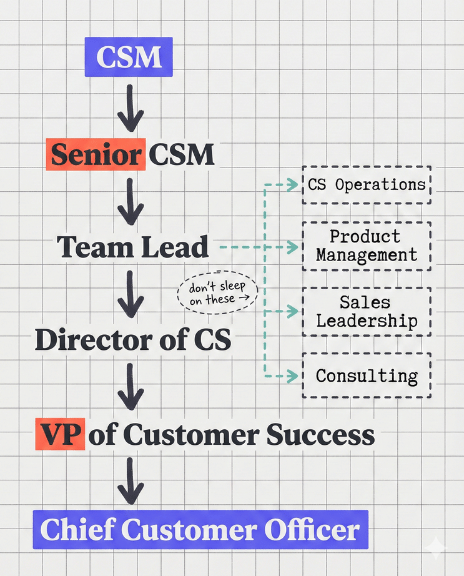
Most CSMs advance to senior positions within 2-3 years. The common progression runs from CSM to Senior CSM to Team Lead to Director to VP of Customer Success to Chief Customer Officer. But the path isn't strictly vertical anymore.
The specialization trend means lateral moves carry real value. CSMs regularly transition into CS operations (designing the systems and playbooks), product management (translating customer insights into roadmap decisions), sales leadership (applying commercial skills developed on the CS side), or consulting. The skills you build as a CSM, especially cross-functional influence, business acumen, and customer empathy, transfer across a surprisingly wide range of roles.
How to know if you'd thrive in this role
The CSM role attracts people from a wide range of backgrounds: sales, consulting, support, implementation, even teaching. There's no single "right" path into the role. But the people who tend to excel share a few traits.
You're naturally curious about how businesses work. Not in an abstract way, but in a "tell me about your tech stack and your quarterly goals" kind of way. You enjoy the puzzle of figuring out why a team isn't getting value from a product and then building a plan to fix it.
You're comfortable with ambiguity. The CSM role rarely has clear playbooks for every situation. You'll encounter accounts that don't fit any template, stakeholders who won't return your calls, and products that don't quite deliver what was promised. If you need rigid structure, this role will frustrate you.
You can hold two truths at once: genuinely caring about your customer's success while also understanding that your company needs revenue growth to survive. The best CSMs don't see this as a conflict. They see it as alignment, because customers who get real value renew and expand.
Frequently asked questions about customer success managers
Q: What does a customer success manager do on a daily basis?
A: A CSM typically reviews customer health scores, conducts check-in calls, monitors product usage data, and collaborates with internal teams. Daily tasks include onboarding new accounts, preparing business reviews, identifying churn risks, and spotting expansion opportunities across their portfolio.
Q: Is a customer success manager a sales role?
A: Not exactly. CSMs influence revenue through retention and expansion but focus on customer outcomes rather than closing new deals. Many CS teams now own renewal and growth targets, but the approach is consultative and relationship-driven rather than transactional.
Q: What skills do you need to become a customer success manager?
A: Strong communication, strategic thinking, and product knowledge are essential. CSMs also need data analysis skills, cross-functional collaboration abilities, and commercial awareness. Most positions require a bachelor's degree and 2-5 years of customer-facing experience.
Q: What is the difference between a CSM and an account manager?
A: Account managers typically focus on contract renewals and commercial negotiations. CSMs focus on ensuring customers achieve their desired outcomes with the product. In practice, these roles overlap at many companies, but CSMs are more proactive and outcome-oriented.
Q: How much does a customer success manager earn?
A: In the United States, average CSM salaries are around $74,500 base with total compensation reaching $141,000 including variable pay. Compensation varies significantly based on experience level, company size, location, and whether the role carries a revenue target.
Q: Do you need a technical background to be a customer success manager?
A: A technical background isn't required but is helpful, especially at SaaS companies with complex products. CSMs need enough technical literacy to understand product functionality, guide customers through configurations, and communicate effectively with engineering teams.
Q: What metrics do customer success managers track?
A: Key CSM metrics include gross revenue retention, net revenue retention, customer health scores, NPS, churn rate, time-to-value, product adoption rates, and expansion revenue. The specific mix depends on the company's CS maturity and business model.
Q: How is AI changing the customer success manager role?
A: AI automates routine tasks like data entry, health scoring, and churn detection, saving CSMs over 10 hours weekly. This shifts the role toward more strategic, high-touch activities. Over 52% of CS teams now use AI tools, with 91% saying AI will significantly impact their CS strategy.
Q: What are the biggest challenges customer success managers face?
A: The top challenges include managing large account portfolios without dropping quality, balancing proactive strategy with reactive firefighting, influencing outcomes across teams without direct authority, and carrying revenue targets without formal sales training. Strong prioritization and internal relationship-building help address these.
Q: What career path does a customer success manager follow?
A: CSMs typically advance to Senior CSM within 2-3 years, then to Team Lead, Director, VP of Customer Success, or Chief Customer Officer. Many also transition into product management, CS operations, sales leadership, or consulting. The skills developed in CS transfer well across multiple business functions.
The CSM role is only getting more important
What a customer success manager does in 2026 is no longer a support function bolted onto the side of a SaaS company. It's the strategic center of the post-sale customer experience, and the data backs it up. Companies that invest in customer success retain more than double the customers of those that don't.
Key takeaways:
- CSMs drive measurable revenue impact through retention, expansion, and customer advocacy
- The role is shifting from reactive relationship management to proactive, data-driven growth strategy
- Investing in customer success delivers significantly higher ROI than pouring more budget into acquisition
What to do in the next 7 days
- If you're hiring a CSM: Define whether the role is strategic, operational, or revenue-focused before writing the job description. Misaligned expectations are the top reason CSMs burn out or underperform.
- If you're considering a CSM career: Start tracking how your current role maps to CSM responsibilities. Build a case study from a customer you've helped succeed and practice framing it in terms of business outcomes.
- If you're already a CSM: Pick one account this week and build a one-page value summary connecting your product's impact to their business goals. Use it in your next check-in instead of a standard agenda.
.png)