
You know the script. You open a success plan, and there it is: a blank field where customer goals should be. You've asked for KPIs. You've tried open-ended questions. You've come to QBRs prepared with frameworks and templates.
And your customer gave you... nothing. Or worse, something vague like "we just want to get more value out of the platform."
CS playbooks often say to ask better discovery questions. But you've done that. You've asked good questions. The problem isn't your questions.
The problem is that asking is the easy part. The hard part is creating conditions where customers actually want to share. That takes demonstrated value, timing, and sometimes helping them figure out what to measure in the first place.
There's a better way to handle this, and it starts before you ever ask for a number.

TL;DR
- Customers withhold metrics for four distinct reasons, and each one requires a different approach. Diagnosing the cause matters more than perfecting your questions.
- Most customers aren't guarding data out of fear. They either don't see the payoff of sharing, don't have the data, see it as extra work, or aren't bought into the product enough to care.
- Bringing valuable data to customers first (benchmarks, usage insights, peer patterns) flips the dynamic from extraction to exchange and makes them far more likely to share back.
Diagnose before you prescribe
Customers don't share metrics for one reason. They don't share for their reason. And if you treat every reluctant customer the same way, you'll keep hitting the same wall.
Four patterns often show up, and each one calls for a different response.
They don't see the payoff yet.
Your customer views the success plan as your project, not theirs. And honestly? They might be right. If the plan lives in a tool they never open, gets updated for your QBR slides, and looks like something you built for your leadership's visibility, why would they invest in it?
Customers treat success plans the way patients treat follow-up appointments: they skip them when they're not convinced the effort is worth it. Your contact is wondering, consciously or not: what do I actually get from sharing these numbers? If adoption is low or usage has stalled, surfacing that in front of their leadership feels like volunteering to look bad when they haven't figured out the story around the numbers yet.
The fix: show the payoff before you ask. Give your contact a preview before anyone else sees the data. Tell them: "I'll never put a metric in front of your leadership that you haven't seen first. And the reason I'm asking for these numbers is so we can build something that proves value to your team, not mine."
When people see what sharing gets them, they share.
They genuinely don't know.
Your customer contact may not have access to the metrics their leadership cares about. Or the data exists but it's scattered across three tools and nobody's ever calculated it. Some customers truly don't know their own business well enough to articulate what success looks like for this purchase. Nobody defined it before they signed the contract, and nobody's defined it since. In other cases, industry or policy constraints restrict what they can share externally. They're not hiding anything. They can't give you what doesn't exist.
You can help them build it. More on that below.
You're asking them to do work for you.
Every data request lands on their to-do list. They're busy. Your success plan isn't their top priority. Even well-intentioned customers will deprioritize requests that feel like effort without a clear payoff for them.
The fix: make the ask smaller, do the legwork yourself when possible, and make it their win, not yours.
They're not bought in.
This is the one CSMs often miss because it feels personal. But your contact may not have chosen this tool. They weren't the champion who fought for the budget. They got assigned the platform and a CSM relationship they didn't ask for. Defining success metrics for something you're lukewarm about feels like a waste of time.
If you're talking to someone who can't discuss business outcomes, only functional tasks ("how do I export this report?"), you may be talking to the wrong level of contact. That's not a metric collection problem. That's a stakeholder problem. The fix isn't a better question. It's finding the person who actually cares about the outcomes this product was purchased to deliver, and building the success plan with them.
From extraction to exchange
So what can we do about this? Stop leading with "What are your goals?" Start leading with "Here's what I'm seeing in your account."

When you bring something valuable to the table first, customers naturally open up. The conversation changes from an interview into a dialogue.
You have more data than you think. Even if your company doesn't hand you polished benchmark reports, you can build lightweight comparisons from your own book of business.
- Share benchmarks. "Customers in your industry typically see X within the first 90 days. You're tracking at Y."
- Share usage insights. "Your team is using Feature A heavily but hasn't touched Feature B, which usually drives [outcome]."
- Share peer patterns. "Other customers with a similar use case have focused on [metric]. Does that resonate?"
- Share risk signals. "I noticed [pattern] in your account that sometimes indicates [problem]. Is that something you're seeing internally?"
If your company doesn't provide formal benchmarks, create rough ones from the accounts you manage. Even directional data ("you're ahead of where similar customers were at this stage") shifts the dynamic.
Then ask the questions that flow naturally from what you've shared:
"Does this match what you're seeing on your end?"
"What would success look like from your leadership's perspective?"
"How would you know in six months whether this investment paid off?"
You've shown you know their account. You've demonstrated that you're invested. Sharing feels like a conversation now, not an extraction.
Three moves that make sharing feel easy
Good questioning techniques matter here. Mirroring, labeling reluctance, using "how" and "what" instead of yes/no questions. I wrote about those in depth in Know What You're Listening For, so I won't rehash them. But for getting metrics specifically, a few additional moves make the difference.
Explain the payoff before you ask.
Customers need a reason to do the work. Before requesting data, make the benefit to them explicit:
"The reason I'm asking is so we can build a success story that proves value to your leadership. You'll have something concrete to show when budget conversations come up."
Frame metric collection as something that protects their credibility, not something that feeds your dashboard.
Shrink the ask.
Instead of requesting a full report, try:
"What's the one number your leadership cares about most?"
"Can you give me a rough estimate? Doesn't need to be exact."
"What's the smallest version of this data I could work with to start?"
Getting something beats getting nothing. You can always build from there.
Do the math yourself.
If you can estimate something from data you already have, do it. Then validate with them instead of asking them to create it from scratch.
"Based on your usage patterns, it looks like your team might be saving around five hours a week on this workflow. Does that feel right?"
"I pulled together some numbers from our side. Can you sanity-check these against what you're seeing?"
This one move changes the entire dynamic. You're not handing them homework. You're handing them a draft and asking for a gut check. The effort shifts from their plate to yours, and the conversation shifts from extraction to collaboration.
And follow up. Then follow up again.
CS culture tends toward accommodation. If a customer doesn't respond to a data request, many CSMs let it drop.
Don't.
Make metric discussions part of every conversation, not just QBRs. Reference open requests naturally: "I know you've been swamped. Still hoping to get those numbers when you have a chance. Want me to send a quick template?"
It's not pushy to care about their success. Persistence, done respectfully, signals that this matters.
Give them a menu, not a blank page
Sometimes customers don't share metrics because they don't know what to track. They bought your product to solve a problem, but never established a baseline or defined what "working" looks like.
You can work with that.
Offer options, not open-ended questions
Customers freeze when faced with "What does success look like for you?" It's too big. Too abstract. Give them something to react to instead:
"Customers like yours typically measure success by time saved, error reduction, or team adoption rate. Which of those feels closest to what your leadership would care about?"
Reacting to options is easier than generating answers from nothing. You're not telling them what to care about. You're giving their thinking a starting point.
Work backward from their boss
People get specific fast when it's about their reputation.
"If your VP asked you in six months whether this was worth it, what would you want to be able to say?"
"What would make you look good in front of leadership at the next review?"
These questions get at what actually matters to your contact, not the official company line they think they should give you.
Build the baseline together
If historical data doesn't exist, help them start tracking now.
"We don't have a starting point yet, but if we begin measuring [X] today, we'll have a comparison by next quarter. That's enough to show a trend."
You're building a measurement system with them. And when customers help define the targets, they're more invested in reaching them. Joint ownership beats imposed metrics every time.
When the numbers stay behind closed doors
Sometimes you won't get their internal numbers. Accept it. That doesn't mean you can't prove value.
Sometimes the barrier isn't willingness. It's organizational. Your contact may be facing internal roadblocks that have nothing to do with your product: reorgs, policy restrictions, uncoordinated resources, or leadership changes that have frozen decision-making. When the customer's own house is in flux, pushing harder for metrics won't help. Working with what you can observe will.
The proxy data you already have often tells a better story than the ROI number you're chasing.
Think about what changes when a customer is actually succeeding. Their support tickets shift from "how do I do this?" to "can I configure this for a more complex use case?" New people start showing up to your meetings. They respond to your emails faster. They ask about features they haven't bought yet.
None of that is ROI. But all of it is evidence. And evidence you can observe is infinitely more useful than a blank field in a success plan.
What's the story your account data is already telling you? If ticket complexity is increasing, that means users are past the basics and pushing into advanced territory. If new stakeholders are joining calls, your product is spreading organically. If response time to your outreach has dropped from days to hours, you've earned attention. If they're asking about renewal terms early or referring you to a colleague at another company, you have something the numbers alone wouldn't capture.
Frame it honestly with your customer: "While we work on getting direct ROI data, here's what I can see from our side that tells me you're on track."
Something interesting happens when you consistently show up with this kind of data. Customers who see you paying close attention to their account often start sharing their internal numbers on their own. You didn't ask for it. You earned it by proving you'd do something useful with whatever data you had.
That's the real unlock. Not a better question. Not a slicker framework. Just consistent proof that you're paying attention.
And revisit what you're measuring. Goals change. What mattered during onboarding might be irrelevant six months in. Check periodically: "Are the metrics we've been tracking still the right ones, or has anything shifted on your end?"
When you do get data, close the loop. Show them what you did with it. Demonstrate that sharing was worth their time. That cycle (share, act, report back) is what turns a one-time data request into an ongoing exchange.
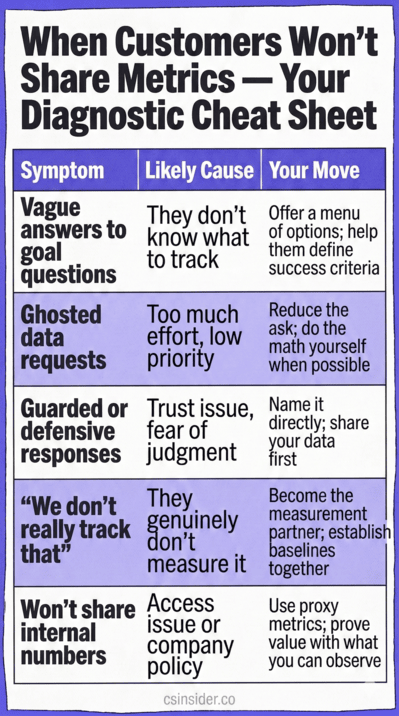
Your diagnostic cheat sheet
When you're stuck, start here. Match the symptom to the likely cause, then pick your move.
Keep this somewhere you can reference it before customer calls. The diagnosis drives the approach. Get it wrong, and you'll keep pushing tactics that don't match the problem.
The question behind the question
Every metric conversation is really two conversations at once. There's the surface-level exchange about numbers and KPIs. And underneath it, there's a different question your customer is asking themselves: "Is this worth my time?"
That second question is the one that determines whether you get real data or polished deflections. And you don't answer it with a better discovery framework. You answer it over weeks and months, through follow-through, through bringing insights before asking for them, through proving that every piece of data they share leads to action they can see.
The CSMs who never struggle to get metrics aren't asking fundamentally different questions. They've built relationships where sharing feels natural because the customer has seen, repeatedly, what happens when they do.
Your success plan should measure something real. Your QBR shouldn't be a scramble. And your renewal conversation should have documented ROI because you built it together. But if you walk away from this article with only one thing, make it this: the next time a customer goes quiet when you ask for numbers, stop and diagnose before you push harder.
Frequently asked questions
Q: What if my company doesn't provide benchmarking data I can share with customers?
A: Build your own. Track patterns across your book of business: average time to first value, common adoption milestones, typical usage levels by segment. Even rough comparisons give you something to lead with. You don't need a polished report. You need enough data to start a conversation.
Q: How do I ask for metrics without sounding like I'm just trying to hit my own KPIs?
A: Frame every request around their benefit, not yours. Instead of "I need this for our success plan," try "If we document this now, you'll have proof of ROI when budget season comes around." When customers see the ask as helping them, it stops feeling like a checkbox exercise.
Q: What if my champion is too junior to access the metrics I need?
A: Help them build the case to get access. Offer to create a one-page value summary they can share upward. Sometimes the best path to senior stakeholder data runs through giving your champion the tools to look good in front of their leadership.
Q: How many metrics should I push for in a success plan?
A: Start with one. A single meaningful metric beats five vague ones. Once you've established a rhythm of tracking and reviewing one number together, expanding to two or three feels natural rather than burdensome.
Q: When should I stop pushing for direct metrics and rely on proxy data instead?
A: If you've tried multiple approaches across three or four conversations and the customer still can't or won't share, shift to proxy metrics without guilt. Some accounts will never give you internal data. That's okay. Proxy metrics still let you demonstrate value and have informed conversations about account health.
.png)