

Customer Success does not run in a controlled environment.
Playbooks matter. They give structure and consistency. But customers change direction. Priorities shift. Issues appear without warning. A CSM who can't adjust when things go sideways will miss critical moments in the customer journey.
Improvisation isn't about throwing out your playbooks. It's a discipline that complements them. It helps you respond with confidence when the predefined path splits, stalls, or disappears entirely.
And here's what most people get wrong: improvisation isn't winging it. Professional improvisers train for years. They drill specific techniques until those techniques become instinct. CSMs can borrow from the same toolkit.
TL;DR 👀
- Playbooks give CSMs structure, but they can't prepare you for every scenario. Crisis calls, disappearing champions, and surprise churn conversations all require improvisation to fill the gap.
- Borrow the "Yes, and" technique from professional improv. When a customer drops unexpected news, accept the reality and build forward in the same breath instead of deflecting or promising to "look into it."
- Read the room before you read your script. If your champion is disengaged or a senior leader joins a call unannounced, your prepared agenda is no longer the priority. Adjust to what's actually happening.
- When complaints about colleagues or other teams land on you, manage the situation for everyone involved. Protect the customer relationship and give your teammate a path to recover.
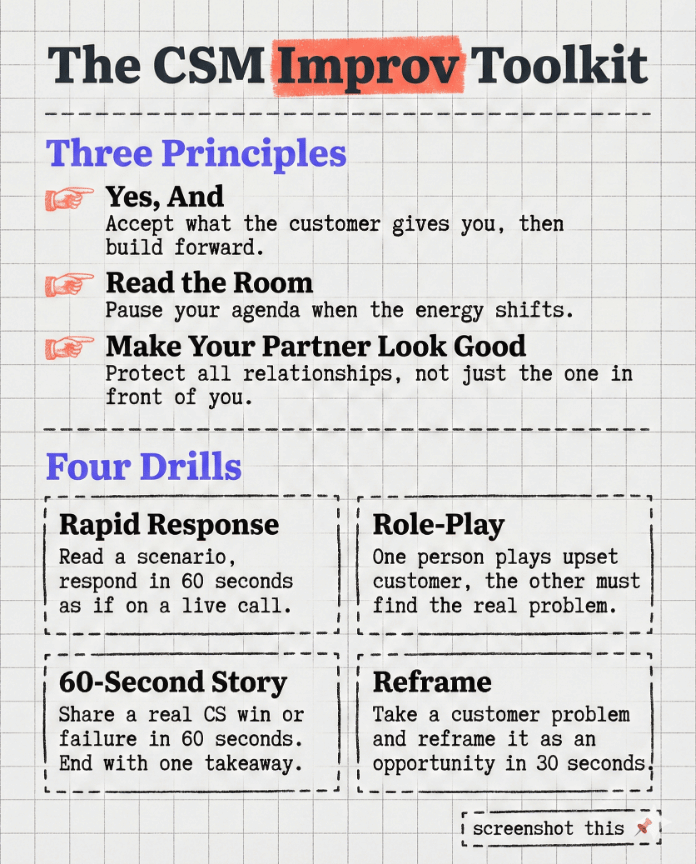
- Improvisation isn't a talent. It's a set of techniques you can practice through team exercises like rapid response drills, role-plays with curveballs, and 60-second storytelling. The instinct builds with repetition.
Two Scenarios That Expose the Limits of Your Playbook
The Crisis Call You Didn't See Coming
Product outage. SLA breach. A severe bug that's impacting your client's business. Your phone rings. Senior leaders are on the line. They want clarity, accountability, and a path forward. Right now.
Following a predefined process might not cut it here. The script wasn't built for this exact situation, this exact tone, or the VP who just joined the call unannounced.
I've been in these moments. Your heart rate goes up. You want to say the "right" thing, but no one wrote it down for you. What matters in that moment is your ability to read the emotional temperature, acknowledge the severity without overpromising, and move the conversation toward next steps.
That's improvisation. Not guessing. Not panicking. Responding to what's actually happening in the room instead of what your playbook assumed would happen.
The Stakeholder Who Disappeared
You're mid-onboarding. Usage looks healthy. Check-in calls are happening. Then your champion goes quiet. Missed calls. Delayed responses. The numbers still look fine, but something feels off.
You can't trust the data and assume "all good." You need to dig.
I had a situation where a very supportive stakeholder left his job without any prior notice. No warm handoff, no introduction to a replacement. Just silence. I eventually had to approach his manager on LinkedIn first to establish initial communication. It was uncomfortable. It worked.
In another case, onboarding was halted when the customer's technical lead was reassigned to another project. The team was stuck. I had to guide them forward and help them justify assigning a new engineer to resume activities. That wasn't in any playbook. It required reading the situation, understanding the internal politics, and adapting my approach in real time.
These moments don't show up in your workflow automation. They require judgment, speed, and the willingness to try something that might not work.
Three Improv Principles Every CSM Should Practice
Professional improvisers don't just "think fast." They rely on specific techniques that have been studied and refined for decades. Three of them transfer directly to Customer Success.
Accept the Scene, Then Build On It
Improvisers call this "Yes, and." When your scene partner says something unexpected, you don't deny it or redirect. You accept the reality they've created and add to it. That's how scenes move forward.
CSMs face this constantly. A customer drops news that changes everything: their executive sponsor left, their budget got cut, and they're being acquired. Your instinct might be to steer back to your agenda or buy time with "let me look into that."
Both responses stall momentum.
Instead, accept what they've given you and build on it. Customer says their executive sponsor just left? "That's a significant change. Who's stepping into that relationship on your side? Let's adjust our success plan to get them up to speed quickly."
You've acknowledged reality and moved forward in one breath. No deflection. No panic. Just a forward-moving response that shows you're on top of it.
This works in churn conversations too. Once a customer shares intent to leave, the standard renewal playbook is mostly irrelevant. Fighting the reality of their decision won't help. Accepting it and building toward a recovery plan will. "I hear you. Before we finalize anything, I'd like to understand what's driving this and explore whether there's a path that works for both of us." That's "Yes, and" applied to the highest-stakes conversation in CS.
Read the Room Before You Read the Script
Improvisers are trained to pick up on emotional tone, energy shifts, and subtext before they decide what to say. They watch their scene partner's body language, listen for what's not being said, and adjust in real time.
On a customer call, this means pausing your agenda when you sense tension, frustration, or disengagement. If your champion is giving one-word answers on a check-in call, your QBR deck doesn't matter right now. Stop and ask what's going on. The information you get from that one question will be worth more than anything on your slides.
I've seen too many CSMs barrel through their prepared agenda while the customer is clearly distracted or upset. They hit every talking point and missed the only thing that mattered.
Sometimes, reading the room creates unexpected opportunities. I've had senior leaders join calls unannounced and ask me to share what other customers are doing, comment on industry trends, or give my honest assessment of their situation. Those moments are a one-shot chance to impress a decision-maker. You can't prepare a deck for a meeting you didn't know was happening. But if you've been paying attention to their business, their industry, and their goals, you can deliver something valuable on the spot.
Waiting to "follow up later" risks losing that momentum entirely.
Make Your Partner Look Good
In improv, your job is to make the other person on stage succeed. You set them up. You support their choices. You never throw them under the bus for a laugh.
This translates directly to how CSMs handle internal escalations and cross-functional tension.
A customer complains about a colleague's performance. Maybe a support engineer dropped the ball, or a sales rep made promises during the deal that aren't materializing. The complaint lands on you because you're the trusted partner.
Your first move isn't to defend your team reflexively or throw someone under the bus. You acknowledge the concern. You assess whether it's valid. Then you drive the resolution in a way that protects both the customer relationship and your colleague's ability to recover.
As a CS leader, I've faced frustrated customers who were unhappy with a specific individual's work. I acknowledged their concerns, assessed whether the criticism was justified, responded transparently, and drove internal improvements when needed. That's improvisation applied to real stakes. You're managing the scene for everyone involved, not just the person in front of you.
This principle also applies to how you work with Sales, Product, and Support internally. When things go wrong with a customer, the CSM who makes their cross-functional partners look good earns more trust, more cooperation, and more leverage for the next time something goes sideways.
Practical Exercises to Build Improvisation Skills
These techniques aren't just concepts. You can drill them. Below are exercises that CS teams can run in team meetings or 1:1s. Each one is designed to be copy-paste ready for a team session.
Rapid Response Drill
How it works: A peer reads a scenario out loud. You have 60 seconds to respond as if you're on a live call with the customer.
Sample scenario: "Your biggest account's VP of Operations just emailed you directly. She says the rollout has been 'a disaster,' her team is losing faith in the product, and she's meeting with your competitor next week. You've never spoken with her before. Your champion has gone silent. What do you say in your reply?"
What a strong response looks like: Acknowledges the severity without being defensive. Asks one clarifying question. Proposes a concrete next step with a timeline. Avoids over-apologizing or making promises you can't keep.
What a weak response looks like: Jumps straight to defending the product. Asks five clarifying questions instead of taking action. Says "I'll loop in my manager" without adding any personal ownership.
Debrief question: "Did you accept the scene or try to redirect it? What's the first thing the VP needs to hear from you?"
Role-Playing Difficult Conversations
How it works: One CSM plays the role of an upset customer with an unexpected complaint. The other CSM must identify the root cause and develop a response. The "customer" should not make it easy. Push back. Add new information mid-conversation.
Sample scenario: The customer starts by saying, "We're not seeing the ROI we were promised." When the CSM asks questions, the customer reveals their internal team isn't using the product correctly, but they don't want to admit that to their leadership. The real issue isn't your product. It's their adoption problem that they need help framing internally.
Debrief question: "At what point did you realize the stated problem wasn't the real problem? How did you adjust?"
60-Second Story
How it works: Share a real success or failure from your CS experience. You have 60 seconds. End with one specific takeaway.
Why it matters: This builds your ability to communicate clearly under pressure. In a crisis call or an executive meeting, you often need to tell a concise story that makes a point fast. Rambling loses trust.
Debrief question: "Could someone who wasn't there understand what happened and why it matters?"
Reframing
How it works: Take a current customer problem and reframe it as an opportunity in 30 seconds.
Sample scenario: "The customer's main power user just left the company." Reframe: "This is a chance to embed the product into their team's process rather than one person's workflow. If the product survives a key person leaving, it's stickier than before."
Debrief question: "Is the reframe honest, or are you just putting a positive spin on a bad situation? There's a difference."
What Improvisation Is Not
One important distinction. Improvising should not pull you away from proven customer management practices. It fills tactical gaps when the standard path is blocked.
Customers who need your help still expect confident guidance. They don't want you freestyling their onboarding. They want someone who knows the process and can adjust it when the situation demands it.
Improvisation is structured problem-solving under pressure. You act with urgency. You focus on what's in front of you. You lean on the fundamentals of CS (active listening, empathy, value delivery, trust) as your foundation when everything else is in flux.
And every improvised response is a learning opportunity. Whether you took an unconventional approach, went in a different direction, or came up with a creative solution on the fly, there's always something to capture. Document what happened. Note what worked and what didn't. Share it with your team. These moments sharpen your judgment and build a playbook for scenarios that no one predicted.
Final Thoughts
Great CSMs balance structure with flexibility. They use playbooks as a base and sound judgment to handle what the playbook never predicted.
With experience, you develop a strong sense of what feels right for the customer and the business. When something is off, you act. You trust your instinct, then verify with data. You adjust when the standard approach doesn't fit.
Improvisation is part of modern Customer Success. The best performers know when to follow the known path and when to pivot. That balance drives stronger customer relationships, builds trust, and leads to long-term success.
The difference? Now you have specific techniques to practice, not just a mindset to adopt. Start with "Yes, and." Read the room before you read the script. Make your partners look good. Drill the exercises. The instinct will follow.
.png)