
You've heard it a hundred times. Talk less. Listen more. Ask open-ended questions.
The advice is correct.
The problem is nobody tells you what to actually do with it.
Listening, in most CS training, gets treated like a personality trait. You either have the instinct or you don't.
That framing misses something important. The best listeners treat listening as an active skill. They know what they're listening FOR before they open their mouth.
TL;DR
- "Listen more" fails as advice because it doesn't tell you what to listen FOR. The best listeners walk into conversations knowing what they need to surface.
- Before every call, form a hypothesis about what's really going on. "I think X is happening because of Y." Then ask questions that test it.
- When customers give surface-level answers, repeat their last few words and wait. The silence makes them go deeper without feeling interrogated.
- Ask "What have you already tried?" to separate real pain from hypothetical pain. If they haven't tried to solve it, they won't pay for a solution.
- Pay attention to what customers leave out. When someone calls something a "top priority" but keeps canceling meetings, their behavior is telling you more than their words.
The problem with "ask better questions"
The standard playbook for CSM conversations says to prepare some open-ended questions, take notes, summarize what you heard, and offer solutions. It works fine for surface-level check-ins. But it treats every goal separately. You do discovery to understand their world. You do QBRs to measure progress. You do expansion conversations to identify upsell opportunities.
That fragmented approach creates two problems.
First, it's exhausting for everyone. Customers get tired of answering the same baseline questions from different people at different stages. CSMs end up running the same plays over and over, gathering information that lives in notes but never turns into strategic insight.
Second, passive listening misses too much. When you show up to a call with a generic list of questions, you're hoping useful information will emerge. Sometimes it does. More often, you get polite, surface-level answers that don't reveal what's actually going on.
The people who are really good at this do something different. They walk into conversations with a theory about what's happening. Then they test that theory with targeted questions. Every question serves the diagnosis.
Form a hypothesis before the call
Management consultants are trained in what's commonly called hypothesis-driven problem solving. Before you gather data, make an educated guess about what you'll find. Then design questions to prove or disprove it.
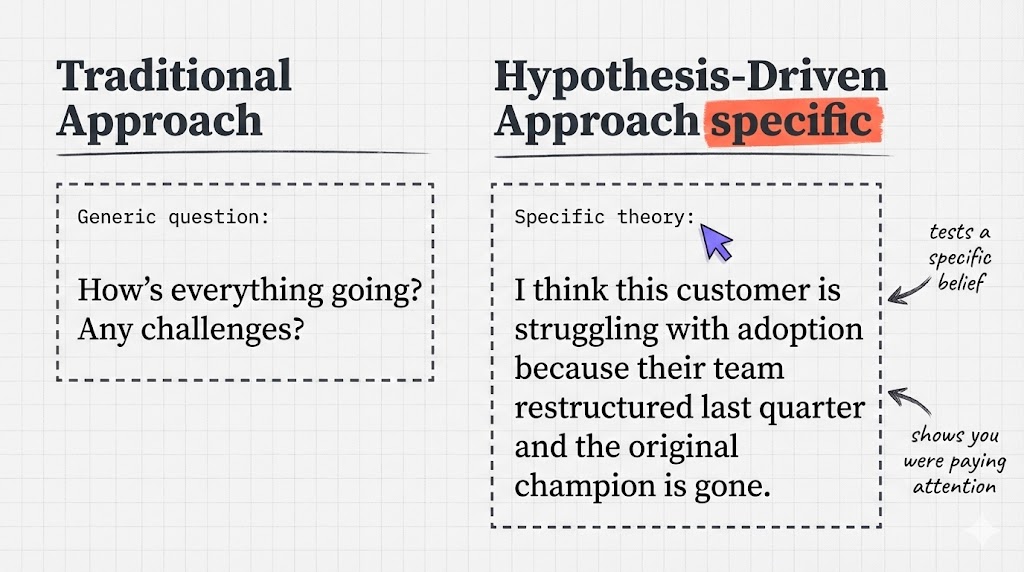
The typical CSM conversation starts broadly. "How's everything going? Any challenges?"
Those questions cast a wide net. Sometimes they catch something. Often they don't.
A hypothesis-driven conversation starts with a specific belief. "I think this customer is struggling with adoption because their team restructured last quarter and the original champion is gone."
That belief might be wrong. But it gives you a direction.
Instead of "How are things going with the platform?" you say: "Last time we talked, you mentioned the reporting rollout was slower than expected. I've been thinking about whether that's connected to the team changes. Is that still creating friction, or has something else become the bottleneck?"
That one question shows you were paying attention. It surfaces something they may not have planned to raise. And it tests your theory.
The hypothesis doesn't have to be right. It just has to be specific enough to guide your listening.
Six techniques for drawing out what matters
You walked in with a hypothesis. These techniques test it.
Use them when you need to steer toward a specific goal. Dig into one thread until you hit something concrete.
When you need to test if the pain is real: Ask what they've tried
Rob Fitzpatrick nails this in The Mom Test. People tell you what they think you want to hear. To get truth, ask about what they've done, not what they plan to do.
If a customer is struggling with adoption, ask what they've already done to fix it.
If they've tried multiple things and nothing worked, the pain is real.
If they haven't tried anything, it probably isn't urgent enough to matter.
One question. It tells you how serious the pain is and whether there's budget behind it, without asking about either directly.
When you need to find the root cause: Ask why, then keep asking
When a customer gives you a surface answer, ask why. Then ask why again. Keep going until you hit something concrete.
Customer: "We're too busy to fully roll this out."
Why? "Our team is underwater with the migration project."
What do you think is making it take longer than planned? "We underestimated the data cleanup required."
What happened with the systems that created so much cleanup work? "We merged two systems last year and never reconciled them."
Now you have something useful. The adoption problem traces back to technical debt from a merger.
That changes what help looks like.
When a direct question would backfire: Ask "what" or "how" instead
Some questions put people on the spot. "Can you get budget for this?" forces a yes or no, and most people default to no when they're not sure.
"Do you have authority to sign off on this?" feels like you're sizing them up. Direct questions like these create pressure, and pressure makes people defensive.
"What" and "how" questions work differently. They invite the other person to think out loud with you instead of defending a position.
Instead of "Can you get budget for this?" ask "What would need to be true for this to become a budget priority?" Instead of "Will your boss approve this?" ask "How do decisions like this usually get made on your team?"
They do the thinking. You get the roadmap. And they don't feel like they're being put on trial.
When they give a short or vague answer: Mirror and wait
Chris Voss, former FBI hostage negotiator, teaches this in Never Split the Difference. Repeat the last one to three words your customer said with a slight upward inflection. Then wait.
Customer: "We're just not seeing the ROI we expected."
You: "The ROI you expected?"
Let the silence sit. They'll fill it, usually with something they weren't planning to say.
Mirroring signals you're listening without steering. They choose where to go next.
When you sense emotion underneath: Label it
Name the emotion you're hearing.
"It sounds like you're frustrated with how long this is taking."
"It seems like there's some pressure from above to show results."
Get it right and two things happen. The customer feels understood, which builds trust. And they often correct or expand on what you said, giving you more information.
When you suspect there's more: Ask, "What else?"
This comes from Michael Bungay Stanier, author of The Coaching Habit. He advocates asking "What else?" multiple times in a conversation. The first answer someone gives is usually the obvious one. The second is more considered. By the third or fourth prompt, you're getting to things they hadn't planned to share.
Vary how you ask. "What else is on your mind about this?" Then: "Anything beyond that?" Then maybe just a pause.
The words matter less than the intent: stay curious longer than feels comfortable.
Three gaps that signal the real story
Drawing out information is half the skill. The other half is catching what customers leave out.
Missing pieces
Doctors call these "pertinent negatives." They don't just listen to what patients report. They actively check for what's absent, because missing symptoms narrow the diagnosis just as much as present ones.
The same logic applies to a customer call. If they describe a new initiative but never mention budget, that's a signal. Your hypothesis tells you what should come up. When it doesn't, probe: "You mentioned the rollout timeline but not headcount. Do you have the team to support this?"
Mismatches between words and behavior
A customer says "this is a top priority" but cancels three meetings in a row. Another raves about a feature but hasn't logged in for weeks. The gap between what they say and what they do is where churn risk hides.
When you spot it, don't call out the contradiction directly. Give them room: "I know you mentioned this was a priority last quarter. I noticed the team hasn't logged in much since then. What's getting in the way?"
Perspective gaps
Your contact sees the situation from one angle. Their boss, their end users, and their team see it differently. That gap is invisible until you ask.
"How would your boss describe this situation?" Or: "If I talked to your end users, what would they tell me?"
You learn whether your contact is a champion or isolated, who else cares about the outcome, and where the real decision-making power sits.
Before your next call
The advice was never wrong. Talk less, listen more.
But "listen more" needs a follow-up question: listen for what?
Before your next call, try one thing. Form a hypothesis about what you think is really going on. Write it down. Then build your questions around proving or disproving it.
You'll ask better questions.
You'll notice what they leave out.
You'll catch the gap between what they say and what they do.
That's the difference between showing up curious and showing up prepared.
.png)