

You've heard it all before.
Be proactive. Own the revenue. Build relationships. Drive value.
It's not wrong. It's just exhausted. These phrases show up in job descriptions, performance reviews, and conference keynotes. But often we don't explain what they actually look like at 9 am on a Tuesday when you're staring down 47 unread emails and a renewal that's suddenly at risk.
We don't need more advice. We need translation.
So let's retire the buzzwords and talk about what they actually mean in practice.
1. "Be proactive" and "manage expectations"
These are the same problem wearing different clothes.
Everyone tells you to be proactive. The problem isn't that you don't know this. The problem is bandwidth. You're buried in reactive work because no one built systems to catch problems earlier. Telling you to "be proactive" without changing the conditions that make you reactive is just noise.
"Manage expectations" has the same issue. It sounds reasonable, but it's defensive. You end up spending energy explaining why something didn't happen instead of being clear about what would happen in the first place.
Both of these are really about one thing: building systems that do the work before you have to.
What this looks like in practice:
Build one system this quarter that runs even if nothing's wrong.
At kickoff, set expectations by co-creating a lean success plan tied to business outcomes, not product features. "By day 30, your team will have completed X. By day 60, you'll see Y impact."
Be clear about how you'll work together, too: milestone check-in cadence, response times, and how you'll flag risks.
And set a recurring touchpoint with every account (monthly, biweekly, whatever your capacity allows) to focus on adding value: sharing progress toward their goals, surfacing a relevant insight, or asking questions that uncover issues before they escalate.
Then, hold the line on what you promised.
2. "Own the revenue"
This phrase has become code for "carry a quota without the quota support."
You're supposed to be a trusted advisor AND hit expansion numbers AND somehow not let the commercial pressure mess with the relationship. That's a lot of hats for one head.
Here's the shift: stop trying to own the revenue. Own the value conversation instead. Revenue follows.
What this looks like in practice:
Before every QBR or renewal conversation, answer this question: What business outcome can I prove we influenced?
Not product usage. Not feature adoption. A business outcome their CFO would recognize.
Here's a script you can steal:
"Your team [action] last quarter. Based on [what it replaced], that's roughly [time or effort saved]. At your [cost basis], that's about [dollar impact]."
Example: "Your team processed 1,200 applications last quarter. Based on the manual review process it replaced, that's roughly 200 hours of admin work eliminated. At your average hourly rate, that's about $10K in recovered capacity."
You don't need a perfect ROI model. You need one believable number and the math to back it up. When you show up with that, the expansion conversation stops feeling like a pitch. It starts feeling like a logical next step.
3. "Be a trusted advisor"
Everyone says this. Nobody defines it.
Being trusted doesn't mean being liked. It means being honest when it's uncomfortable.
The CSMs who get taken seriously are the ones who tell customers the truth, even when the truth isn't what they want to hear. They flag the risk the customer is ignoring. They push back on the request that won't serve the customer's goals.
What this looks like in practice:
Your customer wants to add 50 users before they've fully onboarded the first 20. Most CSMs say, "Great, let's talk about the expansion."
Try this instead: "I want to make sure this lands well. Your first cohort is still ramping. If we add 50 more users now, you'll have two groups struggling instead of one succeeding. What if we nail the first 20, document what's working, then use that playbook to onboard the next wave faster?"
You might lose the immediate upsell. But you'll keep the account. And you'll be the person they call when the budget opens up again.
Trust is built in those moments. Not the easy ones.
4. "Build relationships"
Most CSMs build a relationship with their main contact and stop there.
That's a risk. When your champion leaves, there's a good chance the account is in trouble shortly after. If it's a senior leader who leaves, that number jumps up.
The phrase "build relationships" sounds like it's about depth. It's actually about breadth.
What this looks like in practice:
Map the people who matter beyond your champion: the executive sponsor whose name is on the contract, the finance lead who approves renewals, the department head whose team uses your product daily, the IT admin who controls integrations, the skeptic who hasn't bought in yet.
Then find a reason to connect with each of them. Share a relevant insight. Invite them to a QBR. Send a report that speaks to their priorities, not just your champion's.
When your champion leaves (and they will), you'll be glad you did.
5. "Do more with less"
You've been hearing this for three years. The math doesn't work anymore.
At some point, "efficiency" stops being a strategy and starts being a slow march toward burnout.
The real issue isn't that you need to do more. It's that not all work is created equal, and most CSMs spend too much time on low-impact activities.
What this looks like in practice:
Audit your calendar for the last two weeks. Highlight every meeting that didn't move an account forward. That weekly sync that's become a habit instead of a necessity? Question it.
Here's a filter: Before accepting any recurring meeting, ask yourself, "If this meeting didn't exist, what would break?" If the answer is "nothing," cancel it.
Then protect your focus time as if it were a deliverable, because it is. You can't save an account if you're spread so thin you miss the warning signs or can't work on strategic priorities.
6. "Schedule a QBR" and "add value on every call"
QBRs have become a checkbox, not a conversation.
Most CS professionals say traditional QBRs fail to deliver meaningful value. Customers dread them because they're usually slide-heavy data dumps that tell them what they already know. If your QBR is just you reading metrics off a screen for 45 minutes, you're wasting everyone's time.
The same goes for every other standing meeting. "Add value on every call" creates pressure to manufacture value where none exists.
What this looks like in practice:
Stop scheduling meetings because the calendar says it's time. Only meet when you have something worth discussing.
And when you do meet, lead with one insight they don't have. Something they couldn't see without you.
Here's the test: If you removed all the slides from your QBR, would you still have something to say? If the answer is no, you don't have a QBR. You have a report that should've been an email.
Sometimes the most valuable thing you can do is cancel the meeting. Send an async update instead (like a one-page report). Give them 30 minutes back. Respecting their time is value.
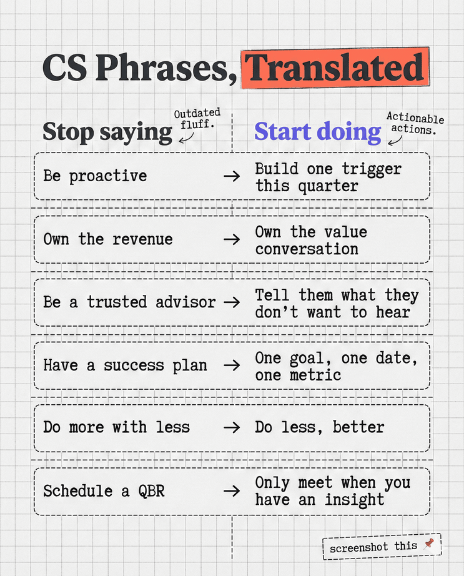
The point
New year, same noise. But you don't have to wait for the industry to catch up.
Pick one thing from this list. Not all six. One.
If you're drowning in reactive work, build the trigger system. If your renewals keep surprising you, go meet the people who aren't your champion. If your QBRs feel like theater, cancel the next one and send a two-paragraph email with one insight instead.
The buzzwords aren't going anywhere. But you can stop waiting for someone to translate them for you.
.png)