
Your feed is full of 2026 predictions right now. Everyone has a take on where customer success is headed. Most of those articles will sit in your bookmarks unread.
We did the reading for you:
- ChurnZero: Essential Customer Success Trends 2026
- SuccessCOACHING: 2026 Customer Success Predictions
- ChurnZero: Customer Growth Trends 2026
- CS Revspeak: The 2026 CS Leader: What’s Changing and What Still Matters
- This is Growth: My Predictions for the Future of CS
- Unchurned: 3 CS Trends That Will Define 2026
- Advocacy Maven: 2026 Customer Success Planning Guide
The same themes kept appearing across sources. So did some real disagreements about what those themes mean for your role. One source says the trusted advisor model is dead. Another says strategic influence is the only defensible advantage left. Both are responding to the same pressure.
That's what we read. Here's what we found, and what it means for your work.
TL;DR
- AI became non-negotiable faster than most teams expected. The gap between AI-enabled CS orgs and everyone else is widening now.
- The CSM role is splitting into two tracks. Strategic advisors who drive expansion. Orchestrators who run systems at scale. The generalist job description is breaking.
- Revenue accountability moved from "closer to revenue" to owning the number. Boards expect CS to forecast expansion the way sales forecasts new logos.
- Process problems got exposed when teams plugged AI into broken workflows. The winners fixed their processes first.
- Efficiency pressure means doing more with fixed headcount. Budgets that rely on hiring more humans to manage growth will be rejected.
1. AI stopped being optional sometime in 2025
Every report names AI as the defining force reshaping customer success. The conversation moved past "should we use AI?" and landed on "how deeply is it embedded?"
Josh Schachter at Gainsight thinks 2026 is the year AI becomes "non-negotiable" in CS. Teams that sat on the sidelines in 2025 will jump in, and the gap between AI-enabled and traditional CS orgs will widen fast. You Mon Tsang at ChurnZero predicts the average CSM will have 25-50% more bandwidth by end of 2026. The gains come from AI handling operational work, not longer hours.
Angeline Gavino's 2025 takeaway was less optimistic. AI didn't magically fix broken CS processes. Teams with messy handoffs found that AI just summarized the mess faster. The problems didn't go away. They became more visible.
The organizations pulling ahead started with their workflows. They mapped what was broken, fixed the process, then asked what parts could be automated. The ones struggling did the opposite. They bought tools hoping technology would solve problems they hadn't diagnosed.
However, Ed Powers expects a correction. Teams will get more skeptical about which tools actually move the needle versus which add complexity. Daphne Costa Lopes draws an even sharper distinction between generic AI assistants and purpose-built agents. Generic assistants that "answer questions about customers" are table stakes. The real gains come from agents designed for specific workflows. An agent that flags expansion opportunities with reasoning. An agent that drafts strategic recommendations based on your best CSMs' playbook patterns. Specific beats general.
How to position yourself in an AI-enabled CS org:
- Audit your workflows before adopting tools by mapping where handoffs break down, where data lives in silos, and where manual work creates bottlenecks. Fix those first.
- Build judgment alongside skills by developing your ability to know when AI recommendations are wrong, when to override suggestions, and how to evaluate outputs critically.
- Focus on work AI struggles with by doubling down on executive relationships, complex negotiations, and situations requiring business context that doesn't live in your systems.
- Experiment with purpose-built applications by identifying one specific workflow where AI could help and testing a focused solution rather than adopting a general assistant.
2. The CSM role is splitting in two
Multiple experts describe the same pattern from different angles. The generalist CSM job description is breaking apart.
Daphne Costa Lopes thinks the role was never one job. It was "three jobs masquerading as one." Organizations hired people to be strategic advisors, project managers, product experts, data analysts, and relationship builders simultaneously. That job description was always impossible.
Two distinct tracks are emerging. Strategic CSMs focus on high-value accounts, business outcomes, and executive relationships. They manage fewer accounts but drive expansion and long-term value. Orchestrator CSMs manage operations, coordinate cross-functional teams, and ensure adoption at scale. They build systems that serve many customers without requiring their direct involvement each time.
Abby Hammer at ChurnZero sees a clear divide in what survives. The job of being a "project manager, status quarterback, or human glue between systems" will rapidly fade. Those who cling to operational ownership will struggle. Those who evolve into strategic, consultative partners will thrive.
Chad Horenfeldt at Siena AI agrees. A CSM's value will hinge on their ability to act as a business advisor, not a product expert focused solely on adoption. Product knowledge is getting commoditized. Customers ask ChatGPT how to use features. Best practices are documented. Implementation playbooks are automated.
What remains is strategic influence. Understanding the customer's business well enough to challenge their thinking, connect dots they're missing, and shape their strategy. Daphne Costa Lopes calls this "the only defensible competitive advantage left" for individual CSMs.
The reports also predict new job titles emerging. Marley Wagner at EverHealth expects to see CS AI Analyst, Customer Intelligence Lead, Customer Signal Architect, and CS Enablement Lead. Jan Young sees new job titles emerging for each track. Forward-Deployed CSMs - essentially on-site consultants dedicated to key accounts - handle high-touch growth. Ops roles build the automated systems that run renewals at scale.
How to prepare for role bifurcation:
- Identify which track fits your strengths by honestly assessing whether you excel at executive relationships and strategic conversations or at building systems, processes, and scalable resources.
- Build evidence for your chosen path by documenting outcomes that demonstrate strategic impact (expansion influenced, executive relationships built) or operational excellence (processes improved, scale achieved).
- Develop the skills your track requires by investing in executive communication, business acumen, and industry knowledge for the strategic path, or systems thinking, automation, and cross-functional coordination for the orchestrator path.
- Have the conversation with your leader by discussing where your role is headed and what the team needs. Waiting for the job description to change leaves you reacting instead of positioning.
3. Revenue accountability moved from concept to expectation
For years, CS talked about getting "closer to revenue." In 2026, the reports describe something more concrete. CS owns the expansion forecast the way sales owns new ARR.
Stijn Smet at Whale, Maranda Dziekonski, and Anika Zubair all see the same shift. CS becomes "a predictable revenue engine" that owns expansion forecasting the same way Sales owns new ARR. CSMs will have clear targets tied to ARR growth. Renewal forecasts will need the same accuracy sales teams bring to new logo projections. And expansion will come from deeper discovery throughout the relationship, not last-minute pitches before renewal.
That ownership comes with scrutiny. Boards aren't satisfied with vague revenue claims anymore. Sheik Ayube sees a new directive emerging: CS must directly contribute to bottom-line results. CS leaders will need to translate their impact in terms of profit, margin contribution, and EBITDA. Top-line growth matters, but proving efficiency matters more.
Rachel Provan sees similar pressure from boards. They're putting much more weight on NRR, especially the retention side. Companies recognize that churn wipes out more revenue than expansion can replace. When you give your executive team clear retention strategies and risk insights they can take into the boardroom, you make their job easier. That's when CS starts getting pulled into rooms where decisions get made.
Sales skills are no longer optional. Kristen Hayer at The Success League thinks CS leaders need solid understanding of sales management best practices. Managing a forecast. Coaching teams on negotiation. Uncovering expansion opportunities.
How to demonstrate revenue accountability:
- Track your expansion influence by documenting which expansions you surfaced, influenced, or directly closed. Build the evidence before anyone asks for it.
- Learn to speak in outcomes by connecting your activities to GRR and NRR impact rather than activity metrics. "These accounts moved from X to Y status, contributing to NRR" beats "I completed 200 customer touchpoints."
- Develop commercial skills deliberately by studying negotiation, learning to run a forecast, and practicing how to position expansion as value delivery rather than a sales pitch.
- Understand the metrics that reach the board by learning your company's targets for GRR, NRR, and contract length. Work backward from what executives are measured on.
4. Value articulation became continuous, not annual
Every report describes some version of the same shift. Proving value can't wait for renewal season anymore.
Ejieme Eromosele thinks customers won't accept soft success metrics anymore, especially as AI companies move toward outcomes-based pricing. They'll demand outcome proof. Dynamic value dashboards. Deeper insights. Co-authored ROI stories. Value demonstration shifts from an annual exercise to "an always-on capability."
Angeline Gavino sees the mindset shifting too. CS teams will stop chasing every new motion and go back to basics. Retention becomes the primary growth engine. The industry is moving to "continuous proof, not last minute proof."
The practical problem is that most CS teams built their QBR process around periodic value reviews. You gather data once a quarter, build a deck, present it, and hope the customer remembers the story when renewal comes. That cadence worked when customers renewed on autopilot. Budget pressure changed the math.
Daphne Costa Lopes proposes splitting business reviews entirely. Usage reviews become quick, data-driven conversations about adoption and health. They happen monthly or become AI-generated updates. Value reviews become strategic sessions with executives focused on business outcomes, future planning, and expansion. QBRs try to accomplish too much at once. Nobody leaves satisfied.
The deeper challenge is that continuous value proof requires continuous value creation. You can't articulate impact you haven't delivered. Ross Fulton at Valuize describes the operating model this requires. Companies will treat customer value realization as "a measurable operating system." Customer journeys centered on prescriptive, measurable outcomes. Integrated processes, systems, and data designed to deliver and verify each outcome.
Amber Monroe at Paradigm predicts traditional health scores get retired entirely. AI-generated "value scores" will calculate a customer's future ROI trajectory and probability of expansion before the customer realizes it. The measurement shifts from what the customer did in your product to what business results they achieved because of it.
How to build continuous value articulation:
- Document milestones as they happen by capturing business impact at each significant moment rather than reconstructing the story at renewal time.
- Build a running value scorecard by maintaining a living document that tracks outcomes achieved, not just features adopted or activities completed.
- Make customers fluent in your value by ensuring they can articulate what they would lose without you. When budget season arrives, they should be defending you before finance asks questions.
- Separate usage conversations from value conversations by designing different cadences and formats for each. Monthly data reviews. Quarterly strategic sessions. Stop trying to accomplish both in 60 minutes.
5. Efficiency pressure is structural, not temporary
Every executive-focused report describes the same constraint. Grow with fixed headcount. Do more with the same team. Scale with tools, not bodies.
The Advocacy Maven report is blunt about the math. If your 2026 customer success plan relies on hiring more humans to manage linear customer growth, your budget will be rejected. Investors are looking at gross margin. A CS team that requires heavy headcount to maintain retention drags down the value of the entire company.
Daphne Costa Lopes sees a counterintuitive outcome. The teams that orchestrate AI and human touchpoints will achieve what was previously impossible: higher retention with fewer CSMs. More customers get a fully digital experience without sacrificing value. Your best CSMs focus on high-value accounts. Retention at scale becomes possible.
Angeline Gavino saw this pressure reshape CS in 2025. Teams had to do more with the same or fewer people. It forced real conversations about segmentation, automation, and focus. The old pattern of every CSM doing everything for everyone did not survive.
The implication for individual CSMs is uncomfortable. Showing that your work produces results that justify your seat matters more than showing that you're busy. The CSMs who survive flat headcount environments can show the math. Results per hour compared to cost per hour.
Kristi Faltorusso points to where efficiency gains come from. Tech stack consolidation will accelerate. There's "75% overlap across 10 tools" in most CS orgs. Platforms are catching up to point solutions. Expect budgets to tighten around fewer, more integrated systems.
How to demonstrate value in a flat headcount environment:
- Identify your highest-ROI activities by tracking time spent versus outcomes influenced across your book of business. Double down on what works. Cut what doesn't.
- Build scalable assets by creating resources, templates, and processes that serve multiple customers without requiring your direct involvement each time.
- Quantify your efficiency gains by documenting specific examples where you achieved results with less effort than previous approaches. CROs respond to this evidence.
- Consolidate your own tool usage by auditing which tools you actually use versus which you pay for. Model the efficiency mindset your organization needs.
6. CS Ops became the strategic function nobody expected
Three years ago, CS Ops was a support role. Data hygiene. Report building. Tool administration. The reports describe something different emerging.
Kristi Faltorusso would make ops her first investment. A strong ops person would be her "first hire" if building a CS team in 2026. The reasoning connects to everything else changing. As AI and automation become more embedded, organizations need people who can design and operate systems, own workflows, and drive productivity across the business.
The role she describes requires a specific skillset. They understand tooling and "start playing around in AI playgrounds themselves." They know how AI connects with tools, systems, and workflows. They anticipate the impact of change. That expertise becomes mission critical.
The SuccessCOACHING report elevates CS Ops even further. CS Ops is no longer a support function. It's "a strategic role that determines how intelligence flows through the business." Playbooks will stop being step-by-step scripts and start branching based on what's actually happening with the customer. Less "do step 1, then step 2" and more "if this, then that." Guidance, not guardrails.
Guy Galon at Obrela predicts entirely new roles under CS and Sales operations. People who can build and connect AI agents to existing tools. The team that controls how customer data, automation, and human touch work together will have the most influence over results.
This shift has implications for CS leaders. The organizations that win with AI will have ops talent who can translate between business needs and technical capabilities. Leaders who delegate AI implementation without understanding it themselves will fall behind. Rod Cherkas predicts AI fluency becomes a leadership requirement. CCOs and post-sale executives will be expected to "show, not just tell" how they use AI.
Kristi Faltorusso models what this looks like in practice. She allocates an hour a day to learning. YouTube tutorials. Building small projects. Testing different platforms. Leaders who dive into AI themselves, who tinker on weekends, who build small agents to solve real problems set better examples than those who mandate adoption from a distance.
How to leverage the CS Ops shift:
- Build a relationship with your ops team by understanding what they're working on, what constraints they face, and how you can support system improvements with frontline feedback.
- Develop basic systems thinking by learning how your tech stack connects, where data flows, and what happens when processes break down. This context makes you more valuable.
- Invest time in AI literacy by carving consistent time to experiment with tools, even 20 minutes a day. Understand capabilities and limitations firsthand.
- Advocate for ops investment by making the case that ops talent enables everything else. Efficiency gains, AI adoption, and scale all depend on the orchestration layer.
7. The experts disagree on what "strategic advisor" actually means
Most reports agree that CSMs need to become more strategic. They disagree sharply on what that means.
The majority position sounds familiar. Chad Horenfeldt sees CSMs acting as business advisors who drive customers' businesses forward. Victoria Shapira predicts the role shifts away from tactical "how-to" questions toward coaching on why and what to do. David Karp warns that CSMs who don't become strategic advisors will be automated out.
Daphne Costa Lopes goes further. Strategic influence becomes "the top CSM skill." Product knowledge is commoditized. What customers can't get from AI is someone who understands their business well enough to challenge their thinking, connect dots they're missing, and influence their strategy.
Then there's the Advocacy Maven take: the "Trusted Advisor" model is dead. The CSM is an asset manager for the vendor. The report argues that customer success exists to protect and grow revenue, full stop. The relationship-first framing obscures the commercial reality of the function.
Both perspectives respond to the same underlying pressure. Boards want CS to prove financial impact. Efficiency demands are squeezing headcount. AI is automating routine work. The disagreement is about how CSMs should position themselves in response.
The trusted advisor camp says lean into strategic value. Become indispensable through insight, relationship, and business impact that AI can't replicate. The asset manager camp says drop the pretense. Own the commercial mandate explicitly. Stop hiding revenue responsibility behind relationship language.
The tension might resolve differently depending on your company, customer base, and segment. Enterprise accounts with complex buying committees probably need strategic advisors. High-volume accounts managed at scale probably need efficient asset managers. The honest answer is that both models will exist. Knowing which one fits your situation matters more than picking the "right" philosophy.
How to navigate the strategic advisor debate:
- Understand what your company actually needs by looking at how CS is measured, how expansion happens, and what successful CSMs in your org actually do.
- Match your approach to your segment by recognizing that enterprise strategic work looks different from scaled commercial efficiency. Both are valid.
- Be honest about the commercial reality by accepting that CS exists to protect and grow revenue. Whether you frame that as "trusted advisor" or "asset manager" matters less than whether you deliver results.
- Develop both capabilities by building strategic influence skills and commercial discipline. The CSMs who thrive will flex between modes based on what each situation requires.
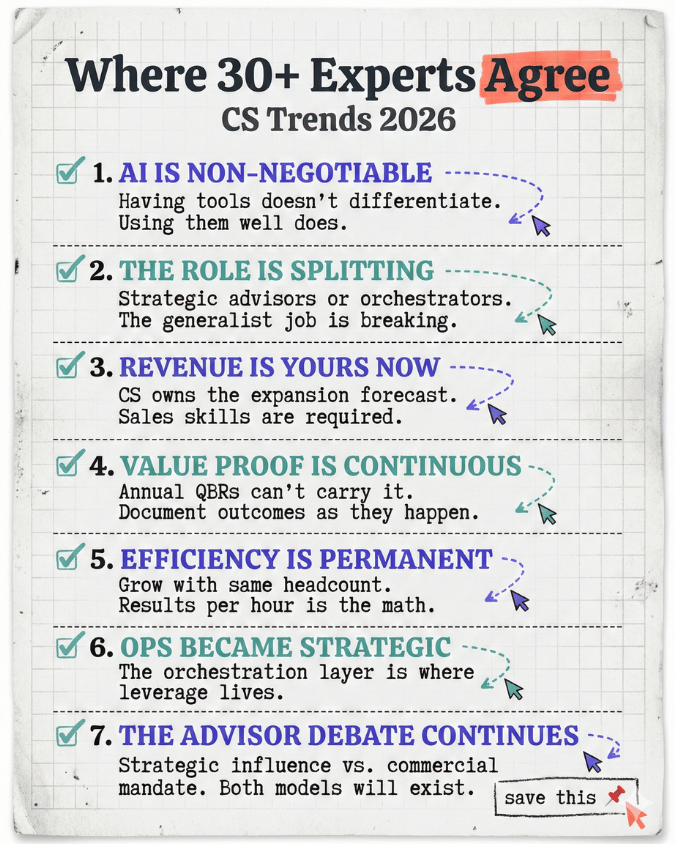
What the reports agree on
Across seven sources with different methods, angles, and contributors, the same patterns kept surfacing:
- AI moved from experiment to expectation. The conversation shifted from adoption to enablement. Having tools doesn't differentiate anyone. Knowing how to use them well, and fixing processes before plugging in automation, separates the leaders from everyone else.
- The CSM role is fragmenting. The generalist job description that combined strategic advisor, project manager, product expert, and data analyst is breaking apart. Two tracks are emerging. Organizations will hire for specific capabilities instead of searching for unicorns who can do everything.
- Revenue accountability became concrete. CS owns the expansion forecast now. Boards expect NRR predictions with the same rigor as new logo forecasts. Sales skills, commercial discipline, and the ability to speak in financial terms are requirements, not nice-to-haves.
- Value proof moved from periodic to continuous. Annual QBRs can't carry the burden of proving impact anymore. The winning teams document outcomes as they happen, build running scorecards, and make customers fluent in articulating value before budget season arrives.
- Efficiency pressure is permanent. "Grow with the same headcount" describes the operating model going forward. The math that matters is results per hour compared to cost per hour. CSMs who can show that math keep their seats.
- CS Ops became strategic. The orchestration layer that connects data, automation, and human intervention is where leverage lives. Ops talent enables everything else. Leaders who understand AI themselves set better examples than those who delegate understanding.
- The trusted advisor debate isn't settled. Most experts say strategic influence is the defensible advantage. Some say the model is dead and CSMs should own the commercial mandate explicitly. The tension probably resolves differently depending on segment and company.
CS is being asked to drive revenue impact while operating with efficiency constraints that tighten every quarter. The reports describe what's changing. Whether your organization adapts how CS operates, and not just what it's called, is a different matter.
Every report agrees the future belongs to CS teams that prove financial value, embed AI into workflows, and elevate human work to strategic impact. Getting there requires letting go of role definitions, processes, and metrics designed for a different era. The question isn't whether the direction is right. It's whether anyone has the support to actually build it.
.png)