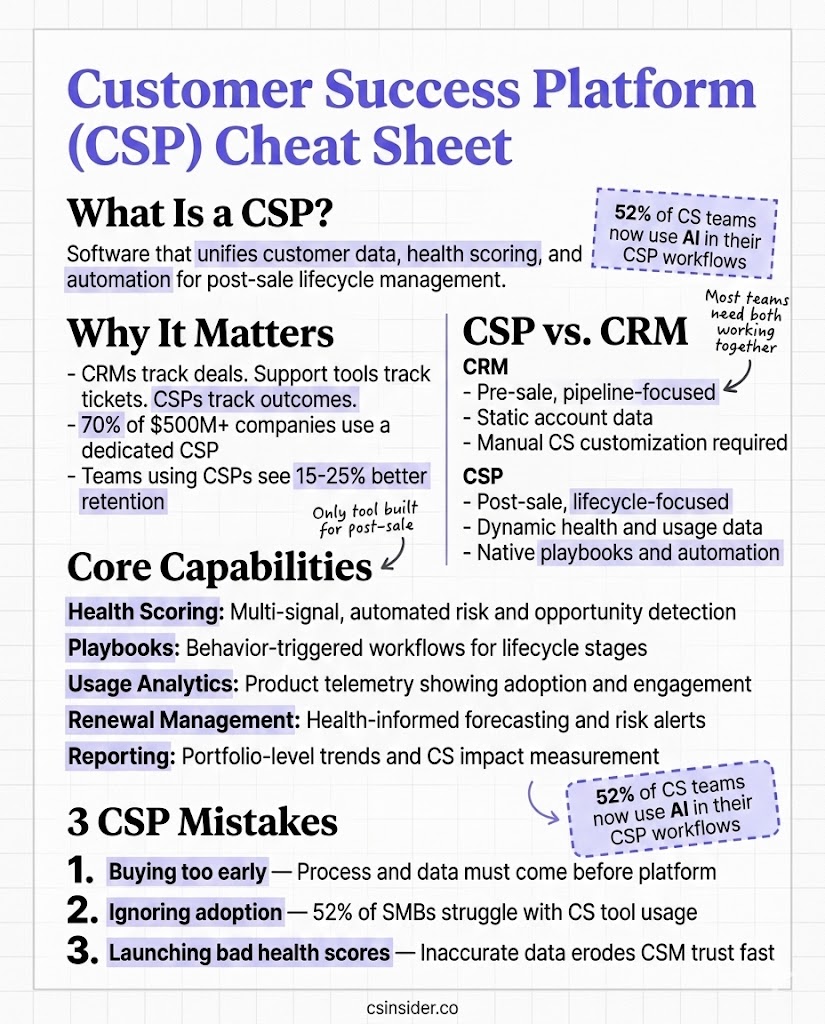
What is a customer success platform?
A customer success platform (CSP) is software designed to help CS teams proactively manage customer relationships after the sale by unifying product usage data, engagement signals, support interactions, and commercial metrics into a single system. It enables health scoring, automated playbooks, renewal management, and expansion identification at scale. A CSP is the operational layer between your CRM and your customer outcomes.
That distinction matters more than it might seem. Your CRM tracks deals. Your support tool tracks tickets. Your product analytics tool tracks feature usage. A customer success platform is the only system designed to pull all of those signals together and answer the question that matters most to your team: is this customer on track to renew and grow, or not?
The CSP market has grown rapidly as SaaS companies recognize that acquisition alone doesn't drive sustainable growth. Mordor Intelligence estimates the customer success management software market at $2.2 billion in 2025, projected to reach nearly $6 billion by 2030. That growth reflects a broader shift: companies investing in the post-sale experience because that's where recurring revenue is protected and expanded.
TL;DR – What you need to know
- A CSP unifies product usage, support, engagement, and commercial data into one post-sale operating system
- 52% of CS teams now integrate AI into their platform workflows for churn prediction and automation
- Companies using advanced CSPs see 15-25% better retention versus CRM-only approaches
- Nearly 70% of large companies ($500M+) use a dedicated CSP, while smaller teams often rely on CRM and spreadsheets
- The biggest risk isn't choosing the wrong platform; it's buying one before your data and processes are ready
Why customer success platforms exist (and what they replaced)
Before dedicated CSPs entered the market, CS teams cobbled together their operating environment from tools built for other teams. The typical setup looked like this: a CRM (Salesforce, HubSpot) for account data, a support platform (Zendesk, Freshdesk) for ticket history, a product analytics tool (Mixpanel, Amplitude) for usage data, and a spreadsheet for everything the other tools couldn't handle.
That patchwork worked when CS teams were small. A CSM with 30 accounts could hold enough context in their head to know which customers needed attention. But when that number climbed to 75 or 150 accounts, the model broke.
The core problem was data fragmentation. A customer might show strong product usage but have three open escalations. Another might have great NPS scores but declining login frequency. Each of those signals lived in a different system, and no single tool connected them into a coherent picture of account health.
CRMs were the first place CS teams tried to solve this. Sales operations teams built custom objects and dashboards inside Salesforce to track health scores and renewal timelines. But CRMs are fundamentally designed around a linear sales pipeline, not a cyclical customer lifecycle. They don't natively ingest product telemetry, they don't trigger automated workflows based on usage changes, and they weren't built to answer "which of my 80 accounts should I prioritize this week?"
That gap is what customer success platforms were designed to fill. The first generation of CSPs started with health scoring and playbook automation. Today's platforms have evolved into full post-sale operating systems with AI-driven churn prediction, digital customer success capabilities, customer education, and revenue forecasting.
Core capabilities of a customer success platform
Every CSP handles the same foundational problem: giving CS teams visibility into account health and the tools to act on it at scale. The specific capabilities vary across platforms, but here's what the category covers.
Customer health scoring
Health scoring is the centerpiece of most CSPs. The platform ingests data from multiple sources (product usage, support tickets, NPS responses, engagement frequency, billing status) and calculates a composite score that indicates whether a customer is healthy, at risk, or somewhere in between.
The value of centralized health scoring is that it replaces gut feel with a consistent, data-driven framework your entire team uses. When a CSM says "this account is yellow," everyone knows what that means because the criteria are defined and applied uniformly.
The challenge is that customer health scores are only as reliable as the data feeding them. Teams that struggle with health score accuracy usually have a data quality problem, not a platform problem. If product usage data is incomplete or support ticket severity isn't weighted correctly, the score will mislead rather than inform.
Playbooks and workflow automation
A customer success playbook in a CSP is a predefined sequence of actions triggered by specific customer behaviors or lifecycle stages. When a customer's usage drops below a threshold, the platform can automatically create a task for the CSM, send a check-in email, or escalate to a manager.
This automation is what allows CS teams to scale without adding headcount proportionally. According to Gainsight's 2025 Customer Success Index, digital CS strategies are growing 15% annually, and self-service portal adoption surged from 42% to 73% in a single year. Much of that growth is powered by CSP automation.
The best playbooks are specific enough to drive action but flexible enough that CSMs don't feel like they're running a script. The platform should suggest what to do next, not remove judgment from the process.
Product usage analytics
CSPs pull in product telemetry to show how customers actually use your product: which features they've adopted, how frequently they log in, how many users are active versus licensed, and whether usage is trending up or down.
This capability is what separates a CSP from a CRM with custom fields. Product adoption data gives your team objective evidence of value realization. A customer might tell you everything is fine in a QBR, but if only 3 of their 50 licensed users logged in last month, there's a disconnect between sentiment and behavior.
Renewal and expansion management
Most CSPs include renewal tracking with pipeline views showing upcoming renewals by date, value, and risk level. Some extend into expansion management, identifying accounts with usage patterns that suggest readiness for upsells or cross-sells.
This capability is increasingly important as CS teams take on more revenue responsibility. The Gainsight CS Index found that 93.7% of companies measuring CS impact now use a revenue target (GRR, NRR, or both).
Reporting and analytics
CSPs provide dashboards that aggregate account health, team performance, and portfolio-level trends. Leaders use these to identify systemic patterns, forecast renewal outcomes, and justify investment decisions. The reporting layer is also where CS teams demonstrate impact to executive leadership. When your net revenue retention improves by 5 points, your CSP should show which interventions contributed to that result.
How to evaluate a customer success platform
Buying a CSP is a significant investment, and the decision should start well before you open a vendor's pricing page.
Readiness signals: do you actually need one?
Not every CS team needs a dedicated platform. If you have fewer than 3 CSMs managing fewer than 100 accounts, a well-configured CRM might be sufficient. The investment in a CSP makes sense when manual processes create real bottlenecks: CSMs spending more time gathering data than acting on it, renewals getting missed, or leadership having no visibility into portfolio health.
ChurnZero's 2024 Leadership Study found that nearly 70% of CS teams at companies with $500M or more in revenue use a dedicated CSP. But teams at smaller companies lean heavily on CRM and support software. That gap isn't just a budget issue. Smaller teams often haven't formalized the processes and data infrastructure that a CSP needs to deliver value.
Integration requirements
A CSP is only as good as the data it can access. Before evaluating vendors, map every system that contains customer data: CRM, support platform, product analytics, billing system, communication tools. Then check which CSPs offer native integrations versus requiring custom API work.
This is where many implementations stall. If connecting your product data to the CSP requires three months of engineering work, your time-to-value will suffer and CSM adoption will lag because health scores won't reflect reality until the data flows.
Scaling considerations
Choose a platform that fits where you are today but can grow with you. A team of 5 CSMs managing 200 accounts has different needs than a team of 30 managing 2,000. Some platforms are purpose-built for startups with fast setup. Others are enterprise-grade systems with deep customization but longer implementation timelines.
Gartner noted in the 2025 Magic Quadrant for Customer Success Management Platforms that generative AI and conversational AI assistants are now expected features in the category. AI-driven churn prediction and automated engagement are moving from differentiators to baseline expectations.
The major customer success platforms
The CSP market has consolidated around a handful of established players, each with a different sweet spot. No single platform is best for every team. The right choice depends on your company size, technical maturity, CRM ecosystem, and how much implementation complexity you're willing to absorb.
Gainsight
Gainsight is the most established enterprise CSP, named a Leader in both the 2025 Gartner Magic Quadrant and the Forrester Wave for Customer Success Platforms. It offers the deepest feature set in the category: advanced health scoring, journey orchestration, success plans, CSQL tracking, product analytics (via Gainsight PX), customer education (via Skilljar acquisition), and community tools. Its Salesforce integration is among the strongest.
The tradeoff is complexity and cost. G2 reviewers consistently cite a steep learning curve and long implementation timelines. Multiple Gartner Peer Insights reviews note that the platform can feel overwhelming, and some teams report needing nearly two years for full deployment. Gainsight typically requires a dedicated administrator. It's best suited for mid-market to enterprise CS organizations with 10+ CSMs and established CS operations.
ChurnZero
ChurnZero holds the #1 position on G2 for Customer Success Software with 1,500+ reviews and a 4.7/5 rating. It's also a Gartner Magic Quadrant Leader alongside Gainsight. Reviewers on G2 and Capterra consistently praise ChurnZero as a platform built by CS practitioners who understand the role. Its in-app engagement tools, real-time usage tracking, and segmentation capabilities are standout features.
ChurnZero's most common criticism across review sites is that its interface can be unintuitive at first, and reporting customization is limited on lower-tier plans. Estimated pricing ranges from roughly $12K to $90K+ per year depending on configuration. It fits best with mid-market SaaS companies (50-1,000 employees) that have dedicated CS operations and clean CRM data.
Totango (merged with Catalyst)
Totango and Catalyst merged to create a combined platform offering. Totango brings modular "SuccessBLOCs" (pre-built CS program templates) and enterprise hierarchy health scoring. Catalyst adds a Salesforce-native workspace and cross-functional collaboration tools. The combined entity also offers Unison AI for predictive insights.
Users on G2 praise Totango's 360-degree customer view and its ability to get started quickly with pre-built templates. The merger introduces some complexity, though: the products remain separate subscription lines, and reviewers note integration challenges with certain CRMs. Totango's free tier for small teams makes it accessible for early-stage CS programs, with paid plans starting around $199/month.
Vitally
Vitally has earned G2's "Best Results" award in the CSP category for multiple consecutive quarters. Its primary differentiator is speed: typical implementation takes 2-3 weeks compared to 8-12 weeks for enterprise platforms. The platform emphasizes customizable Hubs (tailored workspaces), strong playbook automation with branching logic, and a modern UI that reviewers consistently describe as intuitive.
Vitally fits best with growth-stage SaaS companies and teams that value flexibility over prescriptive workflows. Pricing starts around $499/month. Its main limitation compared to enterprise platforms is less depth in advanced analytics and enterprise hierarchy support.
Planhat
Planhat raised $50 million in 2025 to scale its warehouse-native platform globally. Its strongest differentiator is data flexibility: it earns high marks from users for robust data modeling, native warehouse connectivity (Snowflake, BigQuery), and extensibility. Planhat supports complex multi-product hierarchies and offers a Kanban-style board view for pipeline management.
The flexibility comes with a steeper learning curve. Reviewers describe Planhat as a "blank canvas" that requires more upfront configuration work than more opinionated platforms. Pricing starts around $1,000/month. It's a strong choice for data-savvy CS teams at companies with complex product portfolios or mixed B2B/B2C models.
Custify
Custify positions itself as a lightweight alternative to enterprise CSPs, targeting small and mid-market B2B SaaS teams. It offers core CS features (health scoring, automated workflows, customer communication) in a clean interface with fast implementation, typically completing setup within four weeks.
G2 reviewers praise Custify's simplicity and responsive support team. The most common criticism is limited customization and a narrower integration ecosystem compared to larger platforms. Pricing starts around $399/month, making it one of the more accessible options for teams building their first dedicated CS program.
ClientSuccess
ClientSuccess focuses on simplicity and usability for SMB and mid-market CS teams. Reviewers on G2, Capterra, and TrustRadius consistently describe it as easy to configure and intuitive to navigate, with multiple users noting it doesn't require a dedicated administrator. Its SuccessScore health metric, SuccessCycles playbooks, and Gmail/Outlook email integration are frequently cited as strengths. In January 2025, ClientSuccess acquired Product Signals, integrating voice-of-customer data directly into health scoring.
The most common criticisms across review sites involve a limited API, challenges with parent-child account hierarchies, and less robust automation compared to larger platforms. Some reviewers also note that the platform can slow down with large customer lists. ClientSuccess is best suited for SMB to mid-market SaaS teams that want a structured but lightweight CS tool without the complexity or cost of enterprise platforms. Pricing is available on request.
Where CSP implementations go wrong
The customer success platform market is growing fast, but adoption challenges are growing just as quickly. Understanding where teams struggle can save you months of frustration and thousands in wasted investment.
Buying before your foundation is ready
The most common mistake is purchasing a platform before you've defined the processes it will support. A CSP automates and scales your existing CS motions. If you don't have a clear lifecycle model, defined health score criteria, or consistent handoff processes, the platform will amplify confusion rather than resolve it.
Tool fatigue and adoption failure
The Customer Success Collective's 2025 State of CS report found that 52% of SMBs face significant adoption and usage challenges with their CS tools. CSMs already manage interactions across email, CRM, support tools, Slack, and calendar. Adding another system only works if it genuinely reduces effort in one of those other areas.
The CSPs that get adopted are the ones that become the first screen CSMs open each morning because it's where they find their priorities and account context without switching tabs.
Trusting health scores too early
New CSP implementations often go live with health scores that are immediately inaccurate because data integrations aren't complete or scoring weights haven't been calibrated. When CSMs see red accounts they know are healthy (or green accounts that just churned), they lose trust in the system fast. Rebuilding that trust takes much longer than getting it right on the first pass.
Launch the platform with health scores in a "beta" state for 60-90 days. Let CSMs compare scores against their own knowledge, flag discrepancies, and refine the model before making it the official source of truth.
Overengineering automation
It's tempting to automate everything once you have the capability. But over-automated engagement feels robotic to customers and removes the judgment that makes CS relationships valuable. Automation should handle the repeatable logistics (renewal reminders, onboarding milestone tracking, usage alerts) while preserving space for the strategic conversations that drive real retention.
Frequently asked questions about customer success platforms
Q: What is a customer success platform?
A: A customer success platform is software that helps CS teams manage post-sale customer relationships by unifying product usage, engagement, support, and commercial data into one system. It provides health scoring, automated playbooks, renewal management, and analytics to drive retention and expansion at scale.
Q: How is a customer success platform different from a CRM?
A: A CRM tracks deals and sales pipeline activity. A CSP tracks customer health after the sale. CRMs are built around a linear sales process. CSPs are built around a cyclical customer lifecycle with ongoing engagement, adoption tracking, and renewal management. Many teams use both, with the CRM feeding account data into the CSP.
Q: When should a CS team invest in a customer success platform?
A: Consider a CSP when manual processes limit your team's ability to scale: CSMs spend more time gathering data than acting on it, renewals get missed, leadership lacks portfolio visibility, or your team has grown beyond what CRM customization can support. Teams with 3+ CSMs and 100+ accounts typically benefit most.
Q: How much does a customer success platform cost?
A: Pricing varies widely. Some platforms offer free tiers for small teams, with paid plans starting around $200-500 per month. Mid-market platforms typically range from $1,000-5,000 per month. Enterprise solutions like Gainsight don't publish pricing and are typically custom-quoted based on account volume and feature requirements.
Q: Can you use a CRM instead of a customer success platform?
A: You can customize a CRM for basic CS workflows, but it has limits. CRMs don't natively ingest product telemetry, don't trigger playbooks based on usage changes, and weren't designed for ongoing lifecycle management. Building those capabilities in-house requires engineering resources and creates maintenance overhead that grows over time.
Q: What role does AI play in customer success platforms?
A: AI in CSPs handles churn prediction, sentiment analysis, automated engagement recommendations, and content generation for emails and QBR summaries. Gainsight's 2025 Customer Success Index found that 52% of CS teams now integrate AI into their workflows, with 91% saying AI will have moderate to significant impact on their overall CS strategy.
Q: What are the biggest risks of implementing a CSP?
A: The top risks are buying before your processes and data are ready, failing to drive CSM adoption, launching with inaccurate health scores that erode trust, and over-automating customer interactions. Most failed implementations stem from organizational readiness issues, not platform limitations.
Conclusion
A customer success platform is the operating system that connects your customer data, your team's workflows, and your revenue outcomes into a single post-sale layer. The right CSP gives your team the visibility to act proactively and the automation to do it at scale, but only if the processes and data underneath it are sound.
Key takeaways:
- A CSP fills the gap between CRM (pre-sale) and support tools (reactive) by providing proactive, data-driven lifecycle management
- The biggest implementation risk is buying before you've defined your CS processes, health score criteria, and data infrastructure
- AI capabilities are now expected in the category, with churn prediction and automated engagement becoming baseline features
What to do in the next 7 days
- Map your current customer data sources. List every system that contains customer information (CRM, support, product analytics, billing, communication tools) and note which data is accessible, which is siloed, and where the gaps are. This map is the foundation for any CSP evaluation.
- Audit how your team currently identifies at-risk accounts. Is it intuition? Spreadsheet formulas? Reactive signals like support tickets? Document the process (or lack of one) honestly. If you can't describe a consistent method, you need to build that before buying a platform.
- Calculate your CSM-to-account ratio and time spent on data gathering versus customer-facing work. If more than 30% of a CSM's week goes to pulling data from multiple systems, that's a quantifiable case for platform investment. If it's under 15%, a CRM optimization might be the better next step.